

Introduction

In Part 1, we explored how to know if you have the right team — the foundation of every tech organization. And in Part 2, we looked at how to get the best from them — understanding leverage, productivity, and developer experience.
Now it’s time for the third question every board member eventually asks:
Are we working on the right things?
Because even a world-class team, performing at peak efficiency, will fail if their effort is misaligned with the company’s strategic bets.
Are We Working on the Right Things?
Why it matters
Even the best team fails if effort and impact diverge.
Board members and founders look for confidence that engineering time aligns with business priorities — that the bets the company is making are actually being delivered.
When those priorities drift, you don’t just lose output; you lose trust.
Signals / metrics to track
- Alignment ratio: % of work mapped to roadmap or OKRs.
- Work distribution: new features / improvements / performance / keep-the-lights-on (KTLO).
- Progress on key initiatives: milestone or epic health.
- Dependencies & blockers: cross-team or external delays.
Strategic Alignment
I’ve heard this complaint many times from engineering teams:
“We don’t decide what we work on. It’s not fair to measure our effectiveness based purely on outcomes.”
And that’s probably half fair, half bullshit.
It’s true — you can’t evaluate an engineering team purely by customer outcomes if they don’t own product decisions. The success of the entire company should map to customer impact, but engineering still has a responsibility: to ensure that its execution is aligned with the company’s strategic bets.
That’s why it’s critical to monitor alignment continuously — not just at the end of a quarter or milestone.
At every level (exec, director, manager), you want to be able to answer:
- Are teams working on what we agreed is most important?
- Is anything drifting off-strategy that needs attention?
The balance of work types
Another powerful signal here is work type distribution.
If a team’s effort shifts too heavily toward maintenance or performance fixes, it might point to deeper architectural debt, missing automation, or product bottlenecks. Conversely, if almost everything is “new features,” you may be under-investing in reliability or quality.
This metric also matters from a finance perspective. In many regions (e.g., under IFRS or GAAP), some engineering efforts — such as R&D or feature development — can be capitalized as assets, while KTLO or pure performance tuning cannot. Understanding how your engineering time splits across these categories helps both strategic planning and financial reporting.
📊 A quick reference baseline
While every company is different, healthy engineering orgs often show roughly:
- 50–60% on roadmap or feature work (innovation, product bets)
- 20–30% on improvements, refactors, or technical debt
- 10–20% on KTLO, support, or performance work
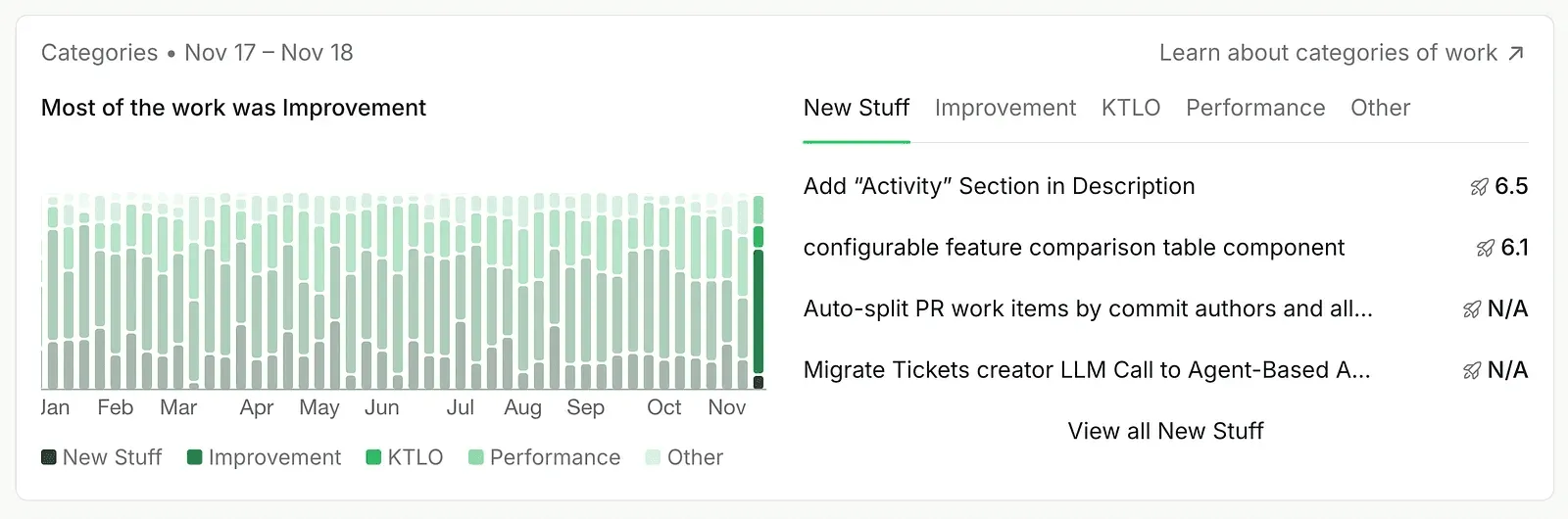
Pensero's type of work distribution
These are broad averages taken from internal analyses at companies like GitHub, Atlassian, and data shared in Will Larson’s “An Elegant Puzzle”, and DORA reports on software delivery.
The exact mix depends on stage and product maturity — startups tend to skew heavily toward innovation, while scale-ups balance toward stability and platform enablement.
How Pensero helps
Pensero automatically categorizes engineering contributions based on the data flowing from your integrated sources — repositories, documentation systems, ticketing tools, even Slack. This lets you visualize your work distribution at any level: organization, group, or team.
We also link contributions to milestones (projects or epics), mapping the percentage of effort aligned with strategic objectives.
Because we aggregate data across many organizations, you can benchmark your alignment and distribution against global baselines, helping you see what “healthy” looks like.
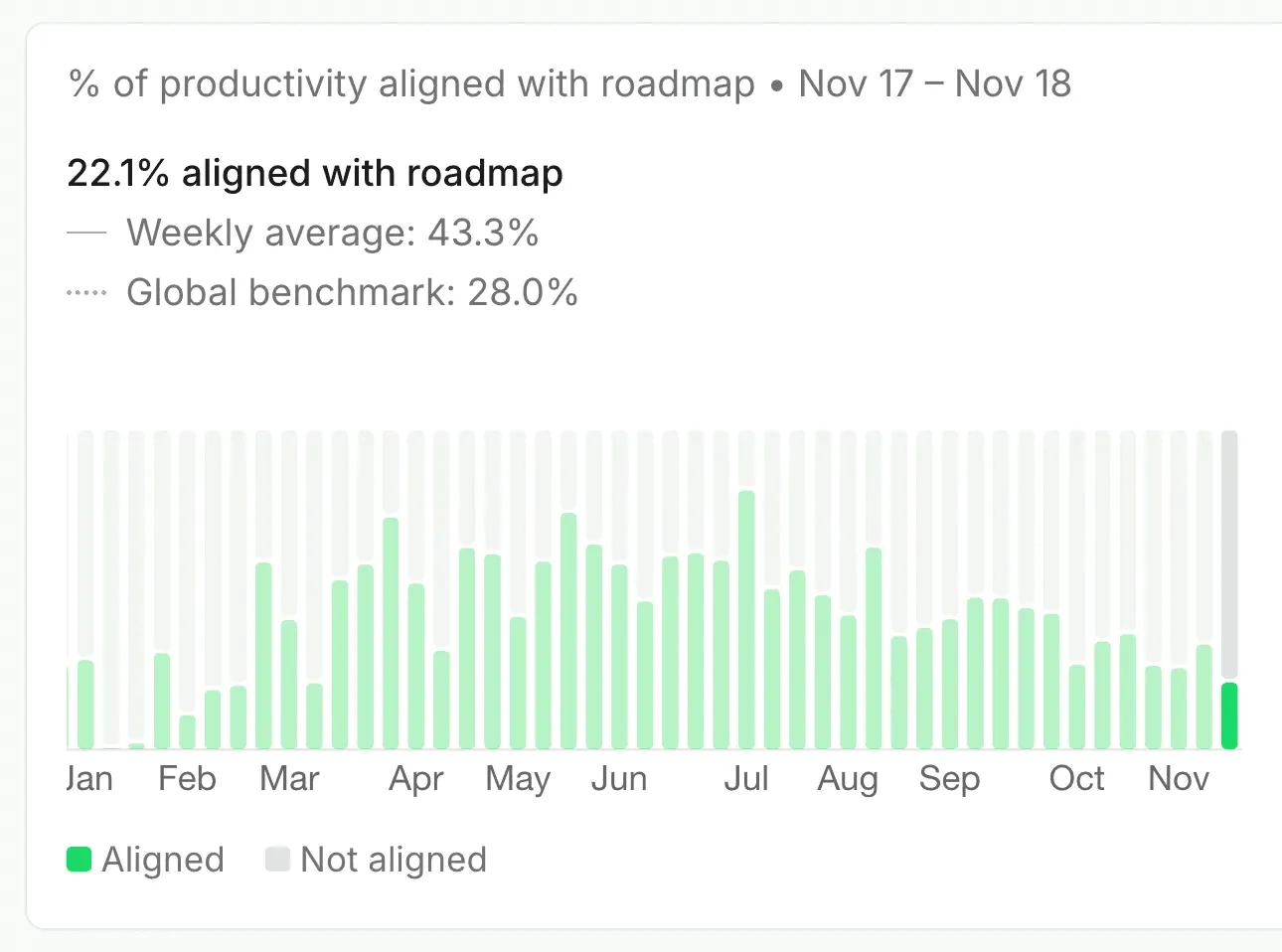
Pensero's strategic alignment trend
Over time, as your organization’s strategy and planning processes mature, your metrics maturity evolves too.
Pensero helps you track that evolution — from rough alignment to fine-tuned strategic execution — until your data becomes reliable enough to inform both operational and board-level decisions.
Closing note
When your team understands not just how they work but why they’re working on something, alignment turns into momentum.
You can stop defending output and start demonstrating impact.
What’s next
Once you know you’re working on the right things, the next question becomes equally vital:
Are we reliable?
In the next article, we’ll explore how reliability becomes the backbone of trust — across your product, your systems, and your leadership story.
If you’ve ever tried to understand your team through data — and felt the frustration of doing it with spreadsheets, or with tools that only rely on ticket lifecycles or member surveys, without getting a holistic and factual view — stay tuned. We’re building something for you.
And if you want to join a blue-ocean opportunity — and help shape how engineering teams navigate this new technology age — check out our careers page.