Best 12 Alternatives to LinearB for Engineering Leaders in 2026

Top 12 LinearB alternatives for engineering management in 2026 to enhance collaboration, performance, and delivery.

These are the best alternatives to LinearB this year:

  1. Pensero

  2. Jellyfish

  3. Swarmia

  4. Waydev

  5. Bilanc

  6. Snapshot Reviews

  7. Entelligence

  8. Taito.ai

  9. Swarmia

  10. Oobeya

  11. Lattice

  12. Culture Amp

Engineering leaders often turn to LinearB for its strong DORA metrics and workflow automation capabilities. The platform has built a solid reputation in the DevOps space, particularly for teams focused on delivery velocity and cycle time optimization.

However, LinearB's heavy emphasis on delivery metrics can feel limiting when you need deeper insights into team dynamics, daily work patterns, or qualitative aspects of engineering productivity. The platform targets organizations with 50+ engineers, and its pricing structure reflects this enterprise focus, starting at $49/month for business features.

Many teams find they need more than just velocity measurements. They want to understand the actual substance of their team's work, communicate progress in language that resonates with non-technical stakeholders, and reduce the administrative burden of tracking productivity.

This guide examines eight compelling alternatives to LinearB, starting with platforms that deliver clarity alongside comprehensive metrics.

The 12 Best Alternatives to LinearB

1. Pensero

Pensero represents a fundamental shift in how engineering intelligence platforms communicate value. Instead of presenting leaders with more dashboards to interpret, it delivers insights in plain language that everyone understands immediately.

Built by a team with over 20 years of average experience in the tech industry, the platform transforms complex engineering data into executive-ready summaries without sacrificing depth or accuracy.

Instead of optimizing dashboards and delivery charts, Pensero focuses on making real engineering work visible. You see what actually happened, not just how fast something moved through a pipeline.
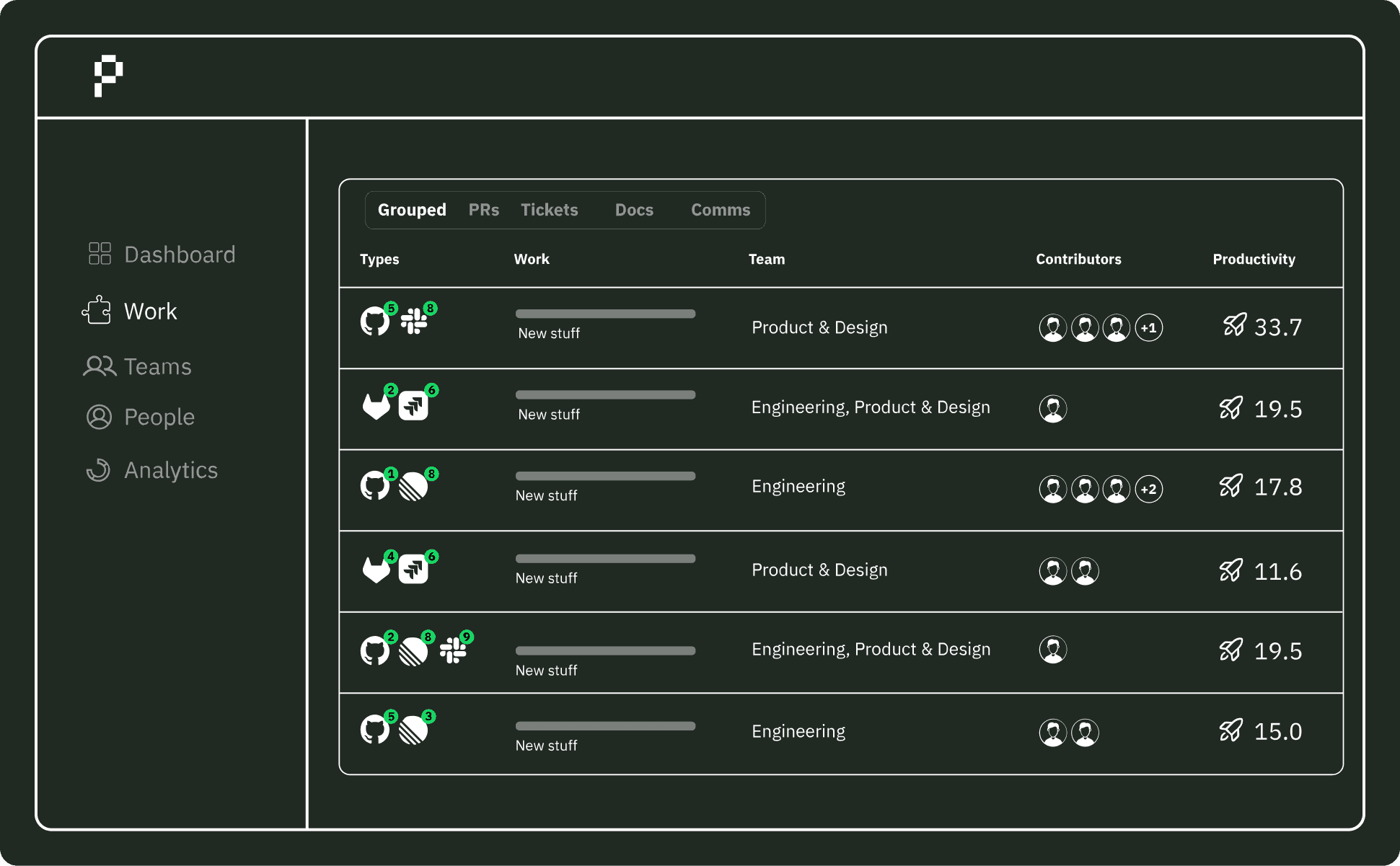
What makes Pensero different

While LinearB focuses on optimizing delivery metrics, Pensero focuses on understanding and communicating the actual work your team accomplishes. The platform's Executive Summaries turn engineering data into simple, human TLDRs every leader understands.

This matters when you're updating stakeholders who don't speak Git, running retrospectives with distributed teams, or simply trying to stay connected to your team's daily progress without micromanaging.

Key capabilities

  • "What Happened Yesterday" provides instant visibility into daily team activity that LinearB's sprint-focused dashboards miss.

  • Body of Work Analysis assesses actual engineering output over time, going beyond velocity and commit counts to understand the substance and quality of work.

  • Executive Summaries automatically generate iteration and sprint summaries in plain language.

  • AI Cycle Analysis delivers understanding of how AI coding tools impact your team's workflow.

  • Industry Benchmarks provide context for your metrics by comparing performance against relevant peers.

What you need to know

  • Integrations: GitHub, GitLab, Bitbucket, Jira, Linear, GitHub Issues, Slack, Notion, Confluence, Google Calendar, Cursor, Claude Code

  • Pricing: Free tier for up to 10 engineers and 1 repository; $50/month premium; custom enterprise pricing

  • Notable customers: Travelperk, Elfie.co, Caravelo

Why Pensero should be your first choice

LinearB excels at delivery optimization for DevOps teams. But if your primary need is understanding your team's work clearly enough to lead effectively, communicate confidently with stakeholders, and make informed decisions quickly, Pensero addresses challenges that pure metrics platforms don't.

The platform doesn't replace delivery metrics, it complements them with the qualitative understanding and clear communication that engineering leadership actually requires day-to-day.

2. Jellyfish

Jellyfish represents the enterprise end of engineering intelligence platforms, offering comprehensive capabilities that extend far beyond LinearB's delivery focus.

With 252 employees and substantial backing, the platform provides Software Engineering Intelligence that unifies development, business, and financial data for R&D organizations.

What it does well

Jellyfish excels at capabilities LinearB doesn't attempt. The platform combines software engineering metrics with financial reporting, resource allocation tracking, and software capitalization automation.

The platform's DevFinOps module automatically generates finance-ready reports showing which engineering efforts qualify as capital expenditures.

Engineering Management features combine Jira and source control data with calendars and finance information to surface team performance and alignment insights.

What you need to know

  • Best for: Larger organizations (100+ engineers) needing comprehensive financial reporting alongside engineering metrics

  • Integrations: GitHub, GitLab, Bitbucket, Jira, Azure Boards, Azure Repos, Jenkins, CircleCI, PagerDuty, OpsGenie, Slack, MS Teams, Google Calendar, Office 365

  • Pricing: Estimated $30–$62.50 per seat per month on annual contracts; $15,000 minimum annual commitment

  • Notable customers: Five9, PagerDuty, GoodRx, DraftKings, Priceline, Clari, Genesys

Worth noting: Jellyfish's comprehensiveness comes with complexity. Teams wanting straightforward insights without extensive configuration may find the platform overwhelming.

Not fully convinced? Check out some other Jellyfish alternatives.

3. Swarmia

Swarmia takes a developer-first approach that contrasts sharply with LinearB's management-focused dashboards.

The Helsinki and New York-based company built a platform emphasizing transparency and team ownership, making engineering data accessible to individual contributors, not just their managers.

What makes it different

While LinearB provides dashboards for managers, Swarmia gives developers insights into their own work patterns, fostering ownership rather than surveillance.

For engineering leaders, the platform still provides DORA metrics and delivery insights, but the framing encourages using data to support teams rather than simply measure them.

What you need to know

  • Best for: Organizations prioritizing developer autonomy, transparency, and sustainable team health

  • Worth noting: Less detailed financial reporting than Jellyfish and less workflow automation than LinearB.

4. Waydev

Waydev specializes in DORA and SPACE framework implementation through customizable dashboards designed for engineering managers.

What it offers

The platform combines quantitative delivery metrics with qualitative team health insights. Its Engagement Module uses developer experience surveys and workload analysis to detect burnout risks.

Deployment flexibility

Waydev offers both SaaS and self-hosted versions.

What you need to know

  • Best for: Data-oriented engineering managers wanting established frameworks without extensive automation

  • Pricing: $45.75 per developer/month (SaaS); $70.75 per developer/month (self-hosted); annual payment required

5. Bilanc

Emerging from Y Combinator's Winter 2024 batch, Bilanc tackles what LinearB doesn’t: performance reviews.

Key strength

Bilanc uses AI to synthesize technical contributions into coherent performance narratives.
Complexity scoring (0–10 scale) provides nuanced understanding beyond commit counts.

Complementary approach

Bilanc complements delivery metrics by addressing the human side of engineering management.

What you need to know

  • Best for: Leaders needing performance insights and automated review generation

  • Pricing: ~€20 per engineer per month

  • Customer highlight: MoonPay

6. Snapshot Reviews

Snapshot Reviews emphasizes code quality analysis alongside performance metrics.

Unique angle

The built-in AI feature analyzes code line-by-line, helping teams maintain quality while meeting deadlines.

What you need to know

  • Best for: Teams emphasizing code quality

  • Pricing:

    • Free: Up to 5 users

    • Basic: $15/user/month

    • AI Enhanced: $40/user/month

Worth noting: Limited market traction suggests evaluating long-term stability.

7. Entelligence

Founded by Aiswarya Sankar (ex-Uber), Entelligence combines AI-driven code review, documentation, and insights.

Key features

  • AI Code Review with context-aware feedback

  • Automated Documentation generated directly from codebase

  • Codebase Chat for natural language queries

  • Team Insights with repository-focused analytics

What you need to know

  • Best for: Teams seeking AI-powered code review and documentation

  • Pricing: Freemium; $20/user/month for paid tier

  • Integrations: GitHub, GitLab, Slack, Notion, Jira, etc.

  • Customers: DigiBee, Chegg, Composio, Citizen Health

8. Taito.ai

Taito.ai focuses on continuous feedback and performance enablement rather than delivery metrics.

Core approach

Taito.ai uses AI to assist with goal setting, aligning personal and organizational objectives.
Its aggregated feedback view captures ongoing feedback throughout the year.

Integration philosophy

Works within Slack, Google Calendar, and HRIS systems without requiring workflow changes.

What you need to know

  • Best for: Organizations wanting ongoing performance enablement

  • Pricing: €10 per employee per month

  • Customers: Supermetrics, Faculty.AI

Worth noting: Still in beta; evaluating fit is key.

9. Swarmia

Swarmia takes a developer-first approach that distinguishes it from LinearB's management-focused dashboards, emphasizing transparency and team ownership over surveillance-style metrics.

What makes it different

While LinearB provides dashboards primarily for managers, Swarmia democratizes engineering data by giving individual contributors direct visibility into their own work patterns. This fosters ownership and self-improvement rather than top-down monitoring.

The platform still delivers DORA metrics and delivery insights for engineering leaders, but frames them in ways that support and empower teams rather than simply measure them.

Key capabilities

  • Developer-facing dashboards that show individuals their own productivity patterns and growth opportunities

  • Team health monitoring that combines delivery metrics with qualitative signals

  • Transparent data access that builds trust rather than creating surveillance anxiety

  • Investment allocation tracking to understand where engineering effort actually goes

What you need to know

Best for: Organizations prioritizing developer autonomy, transparency, and sustainable team health over pure delivery optimization

Integrations: GitHub, GitLab, Jira, Linear, Slack

Pricing: Custom pricing based on team size; contact for details

Worth noting: Less detailed financial reporting than Jellyfish and less workflow automation than LinearB; the focus is team health and transparency

10. Oobeya

Oobeya provides comprehensive software engineering intelligence that helps organizations gather and analyze data from their entire development ecosystem,

What it offers

The platform connects to multiple data sources to provide engineering leaders with a unified view of team performance, quality metrics, and delivery insights. Oobeya's strength lies in its flexibility—teams can customize dashboards and reports to match their specific needs and workflows.

Key capabilities

  • Customizable dashboards that adapt to your team's unique context

  • Multi-source data integration for comprehensive visibility

  • Value stream mapping to identify bottlenecks across your delivery pipeline

  • Team-level and organization-level insights

What you need to know

Best for: Mid-size to large engineering organizations needing flexible, customizable engineering intelligence

Integrations: GitHub, GitLab, Bitbucket, Jira, Azure DevOps

Pricing: 29to3929 to 39 29to39 per seat; up to 100 seats ($6 - 10k/monthenary fee per team)

Notable customers: Mentioned in competitive intelligence but specific logos not disclosed

Worth noting: Requires more setup and configuration than plug-and-play solutions, but offers greater flexibility in return

11. Lattice

Lattice is a comprehensive people management platform that extends beyond pure engineering metrics into performance management, engagement, and development.

What it does well

While LinearB focuses exclusively on software delivery metrics, Lattice addresses the broader context of engineering team management. The platform combines OKR tracking, performance reviews, continuous feedback, and employee engagement surveys into a unified system.

For engineering leaders managing the human side of technical teams, Lattice provides structure around goal-setting, career development, and team health that delivery metrics alone can't capture.

Key capabilities

  • Performance management with customizable review cycles and 360-degree feedback

  • OKR tracking with goal alignment across individual, team, and organizational levels

  • Engagement surveys to measure team satisfaction and identify retention risks

  • One-on-one meeting tools and templates for manager-employee conversations

  • AI-assisted features for drafting performance reviews and synthesizing feedback

What you need to know

Best for: Engineering leaders wanting to combine performance management with delivery metrics; organizations building comprehensive people operations

Integrations: Slack, Teams, JIRA, Gmail, GDocs, Personio, Workday, BambooHR, SFDC

Pricing: Base package (Performance + OKRs) starts at ~$11/employee/month; Engagement adds $4/employee/month; Enterprise pricing custom

Notable customers: Widely recognized by HR organizations; specific engineering-focused customers not disclosed

Compliance: SOC 2 Type II, GDPR

Worth noting: Lattice targets HR and people operations primarily; engineering-specific insights are less developed than dedicated engineering intelligence platforms

12. Culture Amp

Culture Amp represents the most comprehensive approach to employee engagement and performance management, with engineering-specific applications of its broader people analytics platform.

What makes it different

Culture Amp built its reputation on scientifically-designed employee engagement surveys and has expanded into performance management and development. For engineering organizations, this means combining delivery metrics with deeper insights into team satisfaction, burnout risk, and cultural health.

The platform's strength lies in turning survey data and feedback into actionable insights, using AI to synthesize thousands of employee comments into clear recommendations.

Key capabilities

  • Research-backed engagement surveys designed to measure team health accurately

  • Performance management tools including goal tracking, continuous feedback, and review cycles

  • Development planning with career frameworks and growth conversations

  • Analytics that combine engagement data with performance metrics

  • AI-powered analysis that synthesizes qualitative feedback at scale

What you need to know

Best for: Organizations treating engineering team health as seriously as delivery metrics; companies wanting research-backed employee engagement measurement

Integrations: Google Vertex AI for AI features, Slack, Teams, major HRIS platforms

Pricing: Estimated $3-10 per employee per month depending on modules; minimum commitments apply ($9k-$17.6k for 200 employees)

Notable customers: 6,500+ companies including major engineering organizations (specific logos not disclosed in competitive data)

Compliance: SOC 2, GDPR compliant

Worth noting: Culture Amp's comprehensive approach requires buy-in beyond engineering leadership; most effective when adopted organization-wide rather than just for engineering teams

Why Teams Look Beyond LinearB

LinearB excels at what it was built for: DORA metrics, SPACE framework implementation, and workflow automation for DevOps-focused teams. The platform provides real-time dashboards that track cycle time, deployment frequency, and change failure rates with precision.

But this strength can also be a limitation. Engineering leadership isn't just about optimizing delivery pipelines. It's about understanding what your team is building, how they're collaborating, and whether they're working on the right things.

Teams often look beyond LinearB when they need:

  • Human-readable insights instead of technical dashboards. Not every stakeholder understands what "cycle time reduction" means for business outcomes.

  • Qualitative understanding of engineering work beyond velocity metrics. Some of the most important work, refactoring, architectural improvements, fixing code smells, and knowledge sharing, doesn't show up clearly in DORA metrics.

  • Flexible pricing that works for smaller teams or growing startups. LinearB's focus on 50+ engineer organizations leaves many teams looking for more accessible options.

  • Less complexity in their daily workflow. When you need quick visibility into what happened yesterday or last sprint, navigating comprehensive dashboards can feel like overkill.

Beyond DORA: A Modern Framework for Engineering Metrics

While DORA metrics remain a foundational element of measuring software delivery performance, the conversation in 2026 has evolved to a more holistic understanding of engineering excellence. Leading organizations now recognize that a singular focus on throughput and stability, while important, can obscure other critical aspects of team health and productivity. This has led to the widespread adoption of broader frameworks like SPACE (Satisfaction and Well-being, Performance, Activity, Communication and Collaboration, Efficiency and Flow), which provide a more multi-dimensional view of engineering work .

The SPACE framework encourages leaders to look beyond simple output metrics and consider the human and systemic factors that drive sustainable performance. It acknowledges that developer satisfaction, for instance, is not just a "feel-good" metric but a lead indicator of future team performance and retention. Similarly, it emphasizes the importance of collaboration and efficient workflows, recognizing that bottlenecks and friction in the development process can have a significant impact on both delivery speed and developer morale.

SPACE Dimension

Description

Key Metrics (Examples)

Satisfaction & Well-being

How developers feel about their work, the team, and the culture

eNPS, survey results, developer feedback, retention rates

Performance

The outcome of engineering work

Business impact, quality, reliability, customer satisfaction

Activity

The volume and type of work being done

Commit volume, pull requests, code reviews, design docs

Communication & Collaboration

How effectively team members work together

Onboarding speed, discoverability of information, network analysis

Efficiency & Flow

The ability to complete work with minimal friction or delays

Cycle time, time to first review, interruptions, handoffs

By embracing a more comprehensive framework like SPACE, engineering leaders can move from a narrow focus on delivery optimization to a more strategic approach that balances speed, quality, and team sustainability. This shift is crucial for building resilient, high-performing engineering organizations in the long term.

Navigating the Pitfalls: Common Traps in Engineering Metrics

The promise of data-driven engineering leadership is immense, but the path is fraught with potential missteps. As one expert puts it, "What gets measured gets managed, even when it’s pointless to measure and manage it, and even if it harms the purpose of the organisation to do so" . Without a thoughtful approach, metrics can quickly become counterproductive, leading to unintended consequences and a decline in team morale.

One of the most common traps is the tendency to measure everything. In the enthusiasm to become data-driven, leaders often fall into the trap of collecting every metric possible, creating a deluge of data and software analytics dashboards that are difficult to interpret and act upon. This often leads to "metric theater," where data is collected and displayed but doesn't drive any meaningful change. A more effective approach is to start with a specific problem or question and identify the few key metrics that will provide the most insight.

Another significant pitfall is using metrics for individual performance assessment. Engineering metrics are most effective when used to understand and improve systems and processes, not to evaluate or compare individual developers. When metrics are tied to individual performance, it inevitably leads to gaming the system, where developers optimize for the metric rather than for the desired outcome. This can stifle collaboration, discourage risk-taking, and ultimately harm both team culture and product quality.

Finally, it is crucial to avoid a one-size-fits-all approach. The right metrics for a platform team will be different from those for a product team, and what works for a large enterprise may not be suitable for a small startup. Forcing all teams to adopt the same set of metrics ignores the unique context of their work and can lead to resentment and disengagement. Instead, leaders should empower teams to choose the metrics that are most relevant to their goals and challenges, while providing guidance and support to ensure alignment with broader organizational objectives.

How to Choose Your Compass: Selecting the Right Engineering Management Platform

With a growing market of engineering intelligence and management platforms, choosing the right one can be a daunting task. The key is to approach the decision with a clear understanding of your team's specific needs and challenges. A platform that works wonders for one organization might be a poor fit for another. The following criteria can help guide your evaluation process.

First and foremost, the platform must align with your existing Software Development Life Cycle (SDLC) and project workflow. Whether your team follows an agile, DevOps, or a hybrid methodology, the platform should seamlessly integrate with your processes and provide relevant insights. A tool that forces you to change your fundamental way of working is likely to meet with resistance and ultimately fail to deliver value.

Second, consider your team's size and composition. A small, co-located team will have different needs than a large, distributed one. For remote or hybrid teams, features that support asynchronous communication and collaboration are essential. The platform should also be able to scale with your team as it grows, so you don't have to go through the selection process all over again in a year or two.

Finally, integration capabilities are non-negotiable. In an era of ever-expanding SaaS toolchains, a new platform must be able to connect with your existing tools—from your source control and CI/CD pipeline to your project management and communication hubs. A platform that operates in a silo will only add to the "SaaS sprawl" and create more friction for your developers . The goal is to find a platform that unifies your data and provides a single pane of glass for engineering insights, not another isolated data island.

Making the Right Choice

LinearB built its reputation on delivery optimization and DORA metrics, and for DevOps teams, those are invaluable.

But engineering leadership requires more than delivery metrics. You need clarity on the substance of your team's work, communication that resonates across departments, and visibility without extra administrative burden.

Pensero stands out by addressing what delivery metrics miss, the qualitative understanding of engineering work that enables effective leadership.

These are the best alternatives to LinearB this year:

  1. Pensero

  2. Jellyfish

  3. Swarmia

  4. Waydev

  5. Bilanc

  6. Snapshot Reviews

  7. Entelligence

  8. Taito.ai

  9. Swarmia

  10. Oobeya

  11. Lattice

  12. Culture Amp

Engineering leaders often turn to LinearB for its strong DORA metrics and workflow automation capabilities. The platform has built a solid reputation in the DevOps space, particularly for teams focused on delivery velocity and cycle time optimization.

However, LinearB's heavy emphasis on delivery metrics can feel limiting when you need deeper insights into team dynamics, daily work patterns, or qualitative aspects of engineering productivity. The platform targets organizations with 50+ engineers, and its pricing structure reflects this enterprise focus, starting at $49/month for business features.

Many teams find they need more than just velocity measurements. They want to understand the actual substance of their team's work, communicate progress in language that resonates with non-technical stakeholders, and reduce the administrative burden of tracking productivity.

This guide examines eight compelling alternatives to LinearB, starting with platforms that deliver clarity alongside comprehensive metrics.

The 12 Best Alternatives to LinearB

1. Pensero

Pensero represents a fundamental shift in how engineering intelligence platforms communicate value. Instead of presenting leaders with more dashboards to interpret, it delivers insights in plain language that everyone understands immediately.

Built by a team with over 20 years of average experience in the tech industry, the platform transforms complex engineering data into executive-ready summaries without sacrificing depth or accuracy.

Instead of optimizing dashboards and delivery charts, Pensero focuses on making real engineering work visible. You see what actually happened, not just how fast something moved through a pipeline.

What makes Pensero different

While LinearB focuses on optimizing delivery metrics, Pensero focuses on understanding and communicating the actual work your team accomplishes. The platform's Executive Summaries turn engineering data into simple, human TLDRs every leader understands.

This matters when you're updating stakeholders who don't speak Git, running retrospectives with distributed teams, or simply trying to stay connected to your team's daily progress without micromanaging.

Key capabilities

  • "What Happened Yesterday" provides instant visibility into daily team activity that LinearB's sprint-focused dashboards miss.

  • Body of Work Analysis assesses actual engineering output over time, going beyond velocity and commit counts to understand the substance and quality of work.

  • Executive Summaries automatically generate iteration and sprint summaries in plain language.

  • AI Cycle Analysis delivers understanding of how AI coding tools impact your team's workflow.

  • Industry Benchmarks provide context for your metrics by comparing performance against relevant peers.

What you need to know

  • Integrations: GitHub, GitLab, Bitbucket, Jira, Linear, GitHub Issues, Slack, Notion, Confluence, Google Calendar, Cursor, Claude Code

  • Pricing: Free tier for up to 10 engineers and 1 repository; $50/month premium; custom enterprise pricing

  • Notable customers: Travelperk, Elfie.co, Caravelo

Why Pensero should be your first choice

LinearB excels at delivery optimization for DevOps teams. But if your primary need is understanding your team's work clearly enough to lead effectively, communicate confidently with stakeholders, and make informed decisions quickly, Pensero addresses challenges that pure metrics platforms don't.

The platform doesn't replace delivery metrics, it complements them with the qualitative understanding and clear communication that engineering leadership actually requires day-to-day.

2. Jellyfish

Jellyfish represents the enterprise end of engineering intelligence platforms, offering comprehensive capabilities that extend far beyond LinearB's delivery focus.

With 252 employees and substantial backing, the platform provides Software Engineering Intelligence that unifies development, business, and financial data for R&D organizations.

What it does well

Jellyfish excels at capabilities LinearB doesn't attempt. The platform combines software engineering metrics with financial reporting, resource allocation tracking, and software capitalization automation.

The platform's DevFinOps module automatically generates finance-ready reports showing which engineering efforts qualify as capital expenditures.

Engineering Management features combine Jira and source control data with calendars and finance information to surface team performance and alignment insights.

What you need to know

  • Best for: Larger organizations (100+ engineers) needing comprehensive financial reporting alongside engineering metrics

  • Integrations: GitHub, GitLab, Bitbucket, Jira, Azure Boards, Azure Repos, Jenkins, CircleCI, PagerDuty, OpsGenie, Slack, MS Teams, Google Calendar, Office 365

  • Pricing: Estimated $30–$62.50 per seat per month on annual contracts; $15,000 minimum annual commitment

  • Notable customers: Five9, PagerDuty, GoodRx, DraftKings, Priceline, Clari, Genesys

Worth noting: Jellyfish's comprehensiveness comes with complexity. Teams wanting straightforward insights without extensive configuration may find the platform overwhelming.

Not fully convinced? Check out some other Jellyfish alternatives.

3. Swarmia

Swarmia takes a developer-first approach that contrasts sharply with LinearB's management-focused dashboards.

The Helsinki and New York-based company built a platform emphasizing transparency and team ownership, making engineering data accessible to individual contributors, not just their managers.

What makes it different

While LinearB provides dashboards for managers, Swarmia gives developers insights into their own work patterns, fostering ownership rather than surveillance.

For engineering leaders, the platform still provides DORA metrics and delivery insights, but the framing encourages using data to support teams rather than simply measure them.

What you need to know

  • Best for: Organizations prioritizing developer autonomy, transparency, and sustainable team health

  • Worth noting: Less detailed financial reporting than Jellyfish and less workflow automation than LinearB.

4. Waydev

Waydev specializes in DORA and SPACE framework implementation through customizable dashboards designed for engineering managers.

What it offers

The platform combines quantitative delivery metrics with qualitative team health insights. Its Engagement Module uses developer experience surveys and workload analysis to detect burnout risks.

Deployment flexibility

Waydev offers both SaaS and self-hosted versions.

What you need to know

  • Best for: Data-oriented engineering managers wanting established frameworks without extensive automation

  • Pricing: $45.75 per developer/month (SaaS); $70.75 per developer/month (self-hosted); annual payment required

5. Bilanc

Emerging from Y Combinator's Winter 2024 batch, Bilanc tackles what LinearB doesn’t: performance reviews.

Key strength

Bilanc uses AI to synthesize technical contributions into coherent performance narratives.
Complexity scoring (0–10 scale) provides nuanced understanding beyond commit counts.

Complementary approach

Bilanc complements delivery metrics by addressing the human side of engineering management.

What you need to know

  • Best for: Leaders needing performance insights and automated review generation

  • Pricing: ~€20 per engineer per month

  • Customer highlight: MoonPay

6. Snapshot Reviews

Snapshot Reviews emphasizes code quality analysis alongside performance metrics.

Unique angle

The built-in AI feature analyzes code line-by-line, helping teams maintain quality while meeting deadlines.

What you need to know

  • Best for: Teams emphasizing code quality

  • Pricing:

    • Free: Up to 5 users

    • Basic: $15/user/month

    • AI Enhanced: $40/user/month

Worth noting: Limited market traction suggests evaluating long-term stability.

7. Entelligence

Founded by Aiswarya Sankar (ex-Uber), Entelligence combines AI-driven code review, documentation, and insights.

Key features

  • AI Code Review with context-aware feedback

  • Automated Documentation generated directly from codebase

  • Codebase Chat for natural language queries

  • Team Insights with repository-focused analytics

What you need to know

  • Best for: Teams seeking AI-powered code review and documentation

  • Pricing: Freemium; $20/user/month for paid tier

  • Integrations: GitHub, GitLab, Slack, Notion, Jira, etc.

  • Customers: DigiBee, Chegg, Composio, Citizen Health

8. Taito.ai

Taito.ai focuses on continuous feedback and performance enablement rather than delivery metrics.

Core approach

Taito.ai uses AI to assist with goal setting, aligning personal and organizational objectives.
Its aggregated feedback view captures ongoing feedback throughout the year.

Integration philosophy

Works within Slack, Google Calendar, and HRIS systems without requiring workflow changes.

What you need to know

  • Best for: Organizations wanting ongoing performance enablement

  • Pricing: €10 per employee per month

  • Customers: Supermetrics, Faculty.AI

Worth noting: Still in beta; evaluating fit is key.

9. Swarmia

Swarmia takes a developer-first approach that distinguishes it from LinearB's management-focused dashboards, emphasizing transparency and team ownership over surveillance-style metrics.

What makes it different

While LinearB provides dashboards primarily for managers, Swarmia democratizes engineering data by giving individual contributors direct visibility into their own work patterns. This fosters ownership and self-improvement rather than top-down monitoring.

The platform still delivers DORA metrics and delivery insights for engineering leaders, but frames them in ways that support and empower teams rather than simply measure them.

Key capabilities

  • Developer-facing dashboards that show individuals their own productivity patterns and growth opportunities

  • Team health monitoring that combines delivery metrics with qualitative signals

  • Transparent data access that builds trust rather than creating surveillance anxiety

  • Investment allocation tracking to understand where engineering effort actually goes

What you need to know

Best for: Organizations prioritizing developer autonomy, transparency, and sustainable team health over pure delivery optimization

Integrations: GitHub, GitLab, Jira, Linear, Slack

Pricing: Custom pricing based on team size; contact for details

Worth noting: Less detailed financial reporting than Jellyfish and less workflow automation than LinearB; the focus is team health and transparency

10. Oobeya

Oobeya provides comprehensive software engineering intelligence that helps organizations gather and analyze data from their entire development ecosystem,

What it offers

The platform connects to multiple data sources to provide engineering leaders with a unified view of team performance, quality metrics, and delivery insights. Oobeya's strength lies in its flexibility—teams can customize dashboards and reports to match their specific needs and workflows.

Key capabilities

  • Customizable dashboards that adapt to your team's unique context

  • Multi-source data integration for comprehensive visibility

  • Value stream mapping to identify bottlenecks across your delivery pipeline

  • Team-level and organization-level insights

What you need to know

Best for: Mid-size to large engineering organizations needing flexible, customizable engineering intelligence

Integrations: GitHub, GitLab, Bitbucket, Jira, Azure DevOps

Pricing: 29to3929 to 39 29to39 per seat; up to 100 seats ($6 - 10k/monthenary fee per team)

Notable customers: Mentioned in competitive intelligence but specific logos not disclosed

Worth noting: Requires more setup and configuration than plug-and-play solutions, but offers greater flexibility in return

11. Lattice

Lattice is a comprehensive people management platform that extends beyond pure engineering metrics into performance management, engagement, and development.

What it does well

While LinearB focuses exclusively on software delivery metrics, Lattice addresses the broader context of engineering team management. The platform combines OKR tracking, performance reviews, continuous feedback, and employee engagement surveys into a unified system.

For engineering leaders managing the human side of technical teams, Lattice provides structure around goal-setting, career development, and team health that delivery metrics alone can't capture.

Key capabilities

  • Performance management with customizable review cycles and 360-degree feedback

  • OKR tracking with goal alignment across individual, team, and organizational levels

  • Engagement surveys to measure team satisfaction and identify retention risks

  • One-on-one meeting tools and templates for manager-employee conversations

  • AI-assisted features for drafting performance reviews and synthesizing feedback

What you need to know

Best for: Engineering leaders wanting to combine performance management with delivery metrics; organizations building comprehensive people operations

Integrations: Slack, Teams, JIRA, Gmail, GDocs, Personio, Workday, BambooHR, SFDC

Pricing: Base package (Performance + OKRs) starts at ~$11/employee/month; Engagement adds $4/employee/month; Enterprise pricing custom

Notable customers: Widely recognized by HR organizations; specific engineering-focused customers not disclosed

Compliance: SOC 2 Type II, GDPR

Worth noting: Lattice targets HR and people operations primarily; engineering-specific insights are less developed than dedicated engineering intelligence platforms

12. Culture Amp

Culture Amp represents the most comprehensive approach to employee engagement and performance management, with engineering-specific applications of its broader people analytics platform.

What makes it different

Culture Amp built its reputation on scientifically-designed employee engagement surveys and has expanded into performance management and development. For engineering organizations, this means combining delivery metrics with deeper insights into team satisfaction, burnout risk, and cultural health.

The platform's strength lies in turning survey data and feedback into actionable insights, using AI to synthesize thousands of employee comments into clear recommendations.

Key capabilities

  • Research-backed engagement surveys designed to measure team health accurately

  • Performance management tools including goal tracking, continuous feedback, and review cycles

  • Development planning with career frameworks and growth conversations

  • Analytics that combine engagement data with performance metrics

  • AI-powered analysis that synthesizes qualitative feedback at scale

What you need to know

Best for: Organizations treating engineering team health as seriously as delivery metrics; companies wanting research-backed employee engagement measurement

Integrations: Google Vertex AI for AI features, Slack, Teams, major HRIS platforms

Pricing: Estimated $3-10 per employee per month depending on modules; minimum commitments apply ($9k-$17.6k for 200 employees)

Notable customers: 6,500+ companies including major engineering organizations (specific logos not disclosed in competitive data)

Compliance: SOC 2, GDPR compliant

Worth noting: Culture Amp's comprehensive approach requires buy-in beyond engineering leadership; most effective when adopted organization-wide rather than just for engineering teams

Why Teams Look Beyond LinearB

LinearB excels at what it was built for: DORA metrics, SPACE framework implementation, and workflow automation for DevOps-focused teams. The platform provides real-time dashboards that track cycle time, deployment frequency, and change failure rates with precision.

But this strength can also be a limitation. Engineering leadership isn't just about optimizing delivery pipelines. It's about understanding what your team is building, how they're collaborating, and whether they're working on the right things.

Teams often look beyond LinearB when they need:

  • Human-readable insights instead of technical dashboards. Not every stakeholder understands what "cycle time reduction" means for business outcomes.

  • Qualitative understanding of engineering work beyond velocity metrics. Some of the most important work, refactoring, architectural improvements, fixing code smells, and knowledge sharing, doesn't show up clearly in DORA metrics.

  • Flexible pricing that works for smaller teams or growing startups. LinearB's focus on 50+ engineer organizations leaves many teams looking for more accessible options.

  • Less complexity in their daily workflow. When you need quick visibility into what happened yesterday or last sprint, navigating comprehensive dashboards can feel like overkill.

Beyond DORA: A Modern Framework for Engineering Metrics

While DORA metrics remain a foundational element of measuring software delivery performance, the conversation in 2026 has evolved to a more holistic understanding of engineering excellence. Leading organizations now recognize that a singular focus on throughput and stability, while important, can obscure other critical aspects of team health and productivity. This has led to the widespread adoption of broader frameworks like SPACE (Satisfaction and Well-being, Performance, Activity, Communication and Collaboration, Efficiency and Flow), which provide a more multi-dimensional view of engineering work .

The SPACE framework encourages leaders to look beyond simple output metrics and consider the human and systemic factors that drive sustainable performance. It acknowledges that developer satisfaction, for instance, is not just a "feel-good" metric but a lead indicator of future team performance and retention. Similarly, it emphasizes the importance of collaboration and efficient workflows, recognizing that bottlenecks and friction in the development process can have a significant impact on both delivery speed and developer morale.

SPACE Dimension

Description

Key Metrics (Examples)

Satisfaction & Well-being

How developers feel about their work, the team, and the culture

eNPS, survey results, developer feedback, retention rates

Performance

The outcome of engineering work

Business impact, quality, reliability, customer satisfaction

Activity

The volume and type of work being done

Commit volume, pull requests, code reviews, design docs

Communication & Collaboration

How effectively team members work together

Onboarding speed, discoverability of information, network analysis

Efficiency & Flow

The ability to complete work with minimal friction or delays

Cycle time, time to first review, interruptions, handoffs

By embracing a more comprehensive framework like SPACE, engineering leaders can move from a narrow focus on delivery optimization to a more strategic approach that balances speed, quality, and team sustainability. This shift is crucial for building resilient, high-performing engineering organizations in the long term.

Navigating the Pitfalls: Common Traps in Engineering Metrics

The promise of data-driven engineering leadership is immense, but the path is fraught with potential missteps. As one expert puts it, "What gets measured gets managed, even when it’s pointless to measure and manage it, and even if it harms the purpose of the organisation to do so" . Without a thoughtful approach, metrics can quickly become counterproductive, leading to unintended consequences and a decline in team morale.

One of the most common traps is the tendency to measure everything. In the enthusiasm to become data-driven, leaders often fall into the trap of collecting every metric possible, creating a deluge of data and software analytics dashboards that are difficult to interpret and act upon. This often leads to "metric theater," where data is collected and displayed but doesn't drive any meaningful change. A more effective approach is to start with a specific problem or question and identify the few key metrics that will provide the most insight.

Another significant pitfall is using metrics for individual performance assessment. Engineering metrics are most effective when used to understand and improve systems and processes, not to evaluate or compare individual developers. When metrics are tied to individual performance, it inevitably leads to gaming the system, where developers optimize for the metric rather than for the desired outcome. This can stifle collaboration, discourage risk-taking, and ultimately harm both team culture and product quality.

Finally, it is crucial to avoid a one-size-fits-all approach. The right metrics for a platform team will be different from those for a product team, and what works for a large enterprise may not be suitable for a small startup. Forcing all teams to adopt the same set of metrics ignores the unique context of their work and can lead to resentment and disengagement. Instead, leaders should empower teams to choose the metrics that are most relevant to their goals and challenges, while providing guidance and support to ensure alignment with broader organizational objectives.

How to Choose Your Compass: Selecting the Right Engineering Management Platform

With a growing market of engineering intelligence and management platforms, choosing the right one can be a daunting task. The key is to approach the decision with a clear understanding of your team's specific needs and challenges. A platform that works wonders for one organization might be a poor fit for another. The following criteria can help guide your evaluation process.

First and foremost, the platform must align with your existing Software Development Life Cycle (SDLC) and project workflow. Whether your team follows an agile, DevOps, or a hybrid methodology, the platform should seamlessly integrate with your processes and provide relevant insights. A tool that forces you to change your fundamental way of working is likely to meet with resistance and ultimately fail to deliver value.

Second, consider your team's size and composition. A small, co-located team will have different needs than a large, distributed one. For remote or hybrid teams, features that support asynchronous communication and collaboration are essential. The platform should also be able to scale with your team as it grows, so you don't have to go through the selection process all over again in a year or two.

Finally, integration capabilities are non-negotiable. In an era of ever-expanding SaaS toolchains, a new platform must be able to connect with your existing tools—from your source control and CI/CD pipeline to your project management and communication hubs. A platform that operates in a silo will only add to the "SaaS sprawl" and create more friction for your developers . The goal is to find a platform that unifies your data and provides a single pane of glass for engineering insights, not another isolated data island.

Making the Right Choice

LinearB built its reputation on delivery optimization and DORA metrics, and for DevOps teams, those are invaluable.

But engineering leadership requires more than delivery metrics. You need clarity on the substance of your team's work, communication that resonates across departments, and visibility without extra administrative burden.

Pensero stands out by addressing what delivery metrics miss, the qualitative understanding of engineering work that enables effective leadership.

Know what's working, fix what's not

Pensero analyzes work patterns in real time using data from the tools your team already uses and delivers AI-powered insights.

Are you ready?

To read more from this author, subscribe below…