Best 8 Alternatives to Swarmia for Engineering Leaders in 2026
Best 8 alternatives to Swarmia for engineering leaders in 2025: discover platforms that boost visibility, delivery and DevEx.

These are the best alternatives to Swarmia this year:
LinearB
Jellyfish
Haystack
Waydev
Sleuth
Uplevel
Pluralsight Flow
Engineering leaders often discover Swarmia through its refreshing developer-first philosophy. The Helsinki and New York-based company built a platform emphasizing transparency and team ownership, making engineering data accessible to individual contributors, not just managers.
However, Swarmia's developer-centric approach means less detailed financial reporting and management analytics compared to platforms focused on leadership visibility. Teams needing comprehensive resource allocation tracking, software capitalization reporting, or detailed management dashboards may find Swarmia's capabilities limited.
Many engineering leaders need platforms that balance developer empowerment with robust management insights. They want team transparency without sacrificing the visibility and reporting capabilities that leadership responsibilities require.
This guide examines eight compelling alternatives to Swarmia, starting with platforms that deliver comprehensive intelligence while respecting developer autonomy.
The Best Alternatives to Swarmia
1. Pensero
Pensero provides comprehensive engineering intelligence that respects developer autonomy while delivering the management visibility leaders need.
Built by a team with over 20 years of average experience in the tech industry, the platform balances team transparency with leadership clarity, recognizing that healthy organizations need both.
What makes Pensero different
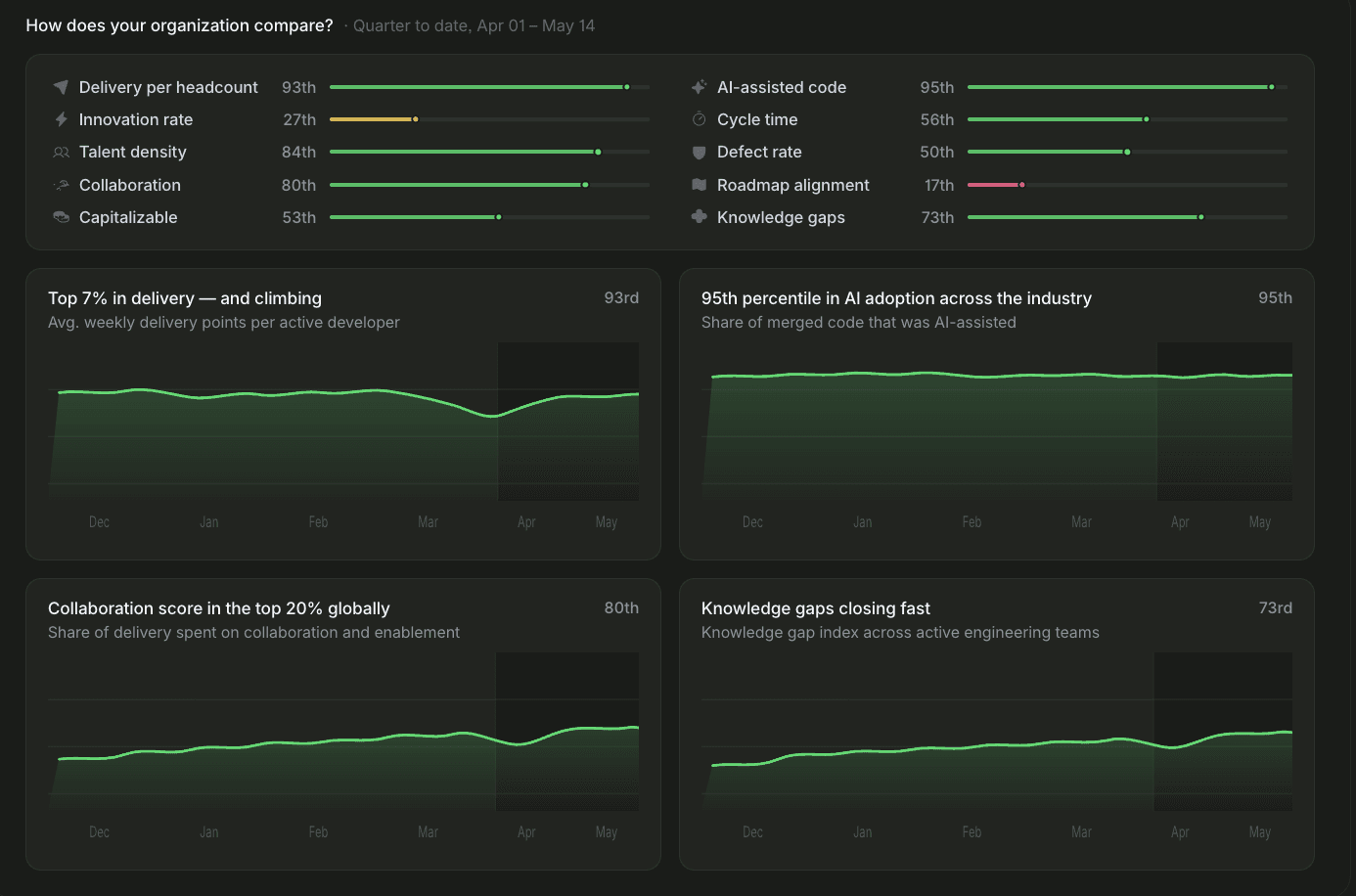
While Swarmia emphasizes making data accessible to developers, Pensero focuses on making insights accessible to everyone. The platform's Executive Summaries turn engineering data into simple, human TLDRs that developers, managers, and executives all understand immediately.
This inclusive approach prevents the visibility gaps that occur when platforms optimize exclusively for either developers or managers. Everyone gets the context they need in language that makes sense for their role.
Key capabilities
"What Happened Yesterday" provides daily visibility that serves both management oversight and team transparency. Developers see their contributions recognized. Managers understand team progress. Executives get clarity without technical jargon.
Body of Work Analysis assesses actual engineering output over time with nuance that respects the complexity of software development. This goes beyond simple velocity metrics to understand the substance and quality of work in ways that serve both team understanding and management evaluation.
Executive Summaries automatically generate iteration and sprint summaries in plain language. These summaries work for retrospectives with developers, updates to executives, and everything in between. One source of truth that communicates clearly to all audiences.
AI Cycle Analysis helps everyone understand how AI coding tools impact team workflow. Developers see how their adoption of AI tools affects their productivity. Managers understand team-wide patterns. Leaders communicate AI investment impact to stakeholders.
Industry Benchmarks provide comparative context that helps both teams and leaders understand performance. Developers gain perspective on their work. Managers set realistic expectations. Executives understand competitive positioning.
What you need to know
Integrations: GitHub, GitLab, Bitbucket, Jira, Linear, GitHub Issues, Slack, Notion, Confluence, Google Calendar, Cursor, Claude Code
Notable customers: Travelperk, Elfie.co, Caravelo
Why Pensero should be your first choice
Swarmia's developer-first philosophy creates healthy team dynamics. But engineering leadership requires serving multiple constituencies simultaneously. Pensero provides comprehensive intelligence that respects developer autonomy while delivering the management visibility and stakeholder communication that leadership responsibilities demand.
The platform doesn't force you to choose between team transparency and management insight. It delivers both through clear communication that works for technical and non-technical audiences alike.
2. LinearB
LinearB brings comprehensive delivery metrics and workflow automation with balanced focus on both team optimization and management visibility.
The platform provides DORA and SPACE metrics alongside automation features that benefit developers and managers alike, including visibility into lead time for changes and deployment flow.
What it does well
LinearB implements delivery optimization that helps teams work more effectively while giving managers the visibility they need through software development KPIs. The workflow automation reduces bottlenecks that frustrate developers while providing metrics that inform management decisions.
Recent AI features include automated PR descriptions and AI-powered code reviews that serve both developer efficiency and quality oversight. This dual focus addresses team needs and management requirements simultaneously.
For teams wanting both developer enablement and comprehensive management analytics, LinearB provides broader capabilities than Swarmia's deliberately focused approach.
What you need to know
Best for: Teams wanting delivery optimization and workflow automation balanced with comprehensive management visibility
Integrations: GitHub, GitLab, Bitbucket, Jira, Slack, and essential development tools
Pricing: Free tier with basic functionality; business features starting at $49/month; custom enterprise pricing
Target audience: Organizations with 50+ engineers
The platform balances team empowerment with management needs more comprehensively than developer-first alternatives, though with corresponding complexity.
3. Jellyfish
Jellyfish provides enterprise-grade engineering intelligence with comprehensive management analytics, resource allocation tracking, and financial reporting capabilities.
The platform serves larger organizations needing business-aligned engineering intelligence that extends well beyond team-level metrics.
What it does well
Jellyfish excels at capabilities Swarmia deliberately doesn't emphasize, especially Jellyfish pricing transparency for enterprise teams. The platform combines engineering metrics with financial reporting, resource allocation tracking, and software capitalization automation that CFOs and senior executives require.
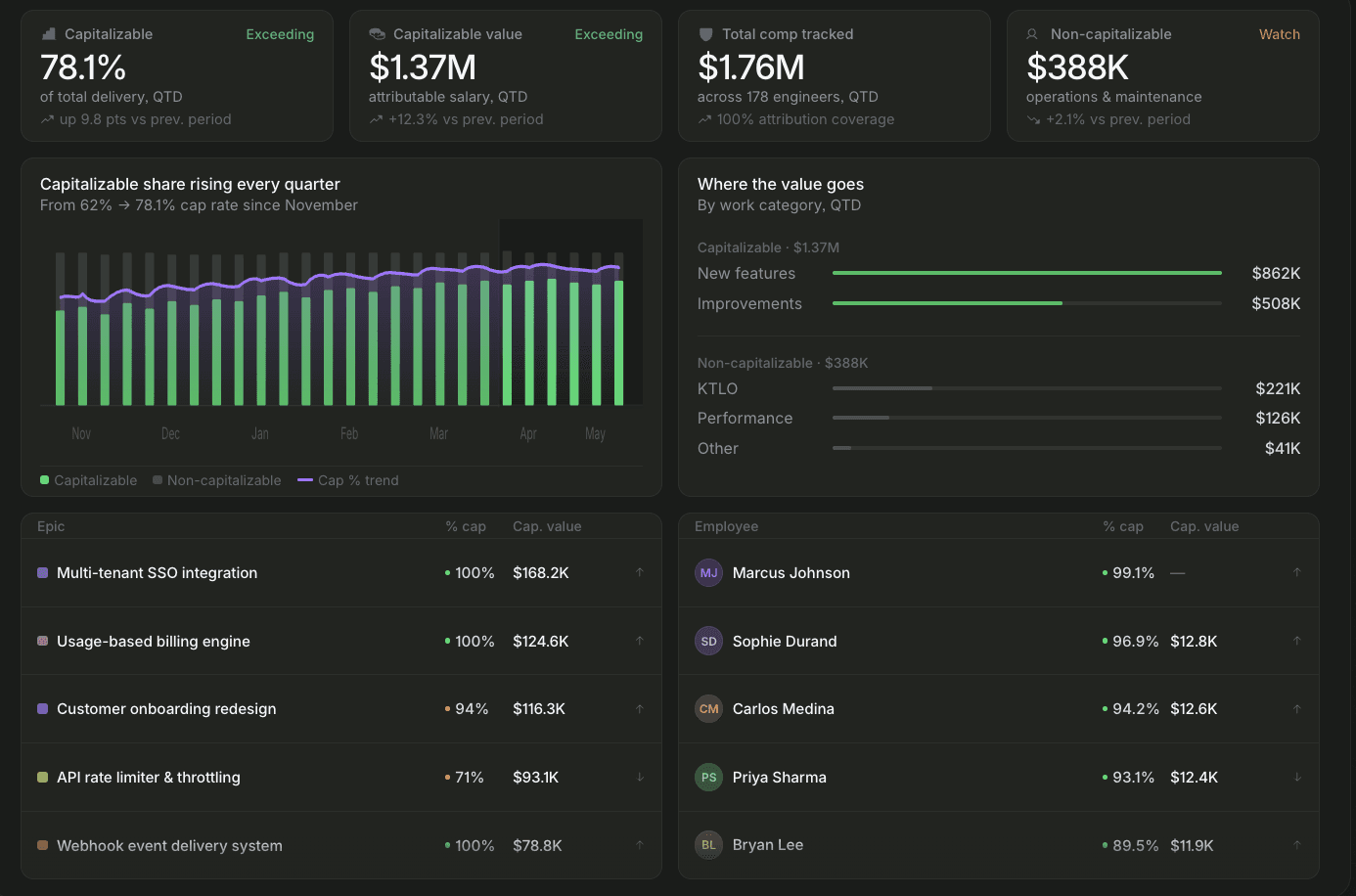
The DevFinOps module automatically generates finance-ready reports showing engineering work as capital expenditures. Investment tracking shows where effort goes by initiative, product line, or work type with business context that team-focused platforms don't provide.
For engineering leaders needing to justify R&D spending, track resource allocation across initiatives, or demonstrate business impact to executives, Jellyfish provides comprehensive capabilities that complement or replace team-focused tools.
What you need to know
Best for: Larger organizations (100+ engineers) needing comprehensive financial reporting and business alignment alongside engineering metrics
Integrations: GitHub, GitLab, Bitbucket, Jira, Azure Boards, Azure Repos, Jenkins, CircleCI, PagerDuty, OpsGenie, Slack, MS Teams, Google Calendar, Office 365
Notable customers: Five9, PagerDuty, GoodRx, DraftKings, Priceline, Clari, Genesys
Worth noting: Jellyfish's comprehensive management focus contrasts sharply with Swarmia's developer-first philosophy. The platform suits organizations prioritizing business alignment and financial reporting over team autonomy emphasis.
4. Haystack
Haystack takes a data-driven approach to engineering intelligence with emphasis on individual contributor productivity and team effectiveness metrics.
The platform provides comprehensive analytics that help both developers understand their work patterns and managers identify optimization opportunities.
What makes it different
Haystack combines individual-level insights with team analytics in ways that serve both constituencies. Developers gain visibility into their own productivity patterns, cycle times, and contribution quality. Managers get aggregated team metrics and comparative analytics.
The platform emphasizes actionable insights over pure measurement, providing recommendations that help both developers improve their workflows and managers optimize team processes.
For organizations wanting data-driven engineering intelligence that serves both team members and leadership, Haystack provides more comprehensive analytics than Swarmia's deliberately simplified approach.
What you need to know
Best for: Organizations wanting detailed individual and team analytics with actionable optimization recommendations
Worth noting: Haystack provides deeper analytical capabilities than Swarmia but requires more active engagement with metrics and recommendations. The platform suits data-oriented teams comfortable with comprehensive analytics.
5. Waydev
Waydev specializes in framework-driven dashboards implementing both DORA and SPACE metrics with emphasis on management visibility and team health monitoring.
The platform provides robust analytics combining delivery metrics with developer experience insights.
What it offers
Waydev implements established frameworks comprehensively, providing structured measurement approaches that balance delivery performance with team wellbeing. The engagement module combines quantitative metrics with developer experience surveys.
The platform's dashboard interface emphasizes management visibility while including developer experience dimensions that Swarmia prioritizes. This combination addresses both leadership oversight needs and team health considerations.
For teams wanting framework-based measurement with both management and developer perspectives, Waydev provides more structured analytics than Swarmia's flexible approach.
What you need to know
Best for: Engineering managers wanting comprehensive DORA and SPACE framework implementation with both team health and delivery metrics
Integrations: GitHub, GitLab, Bitbucket, Jira, limited compared to enterprise platforms
Worth noting: Waydev emphasizes framework adherence and management dashboards more than developer-facing insights. The platform suits teams wanting structured measurement over flexible team empowerment.
6. Sleuth
Sleuth focuses on deployment tracking and change management with emphasis on team visibility into release health and deployment impact.
The platform provides comprehensive deployment analytics that help both developers and managers understand release quality, deployment frequency, and change impact.
What makes it different
Sleuth specializes in the deployment and change management dimensions that comprehensive platforms address more broadly. The focused approach provides deeper deployment insights than general-purpose tools.
The platform tracks deployment frequency, change failure rates, and mean time to recovery with granular detail. Impact tracking shows how individual changes affect system health, helping developers understand deployment consequences.
For teams where deployment excellence represents a primary focus, Sleuth's specialized capabilities provide depth that broader platforms sacrifice for comprehensiveness.
What you need to know
Best for: Teams prioritizing deployment tracking and change management excellence with deep analytics
Worth noting: Sleuth's specialized focus means complementary tools may be needed for comprehensive engineering intelligence. The platform excels at deployment analytics but doesn't attempt broader productivity or team health measurement.
7. Uplevel
Uplevel provides engineering intelligence with emphasis on deep work patterns, meeting burden analysis, and team collaboration health.
The platform analyzes calendar data alongside code metrics to understand how time allocation affects developer productivity and team effectiveness.
What it offers
Uplevel's unique strength lies in connecting time allocation patterns to engineering productivity. The platform identifies how meeting burden, context switching, and collaboration patterns affect individual and team output.
Calendar integration provides insights that code metrics alone miss. Developers see how their time allocation affects productivity. Managers identify meeting overhead and collaboration bottlenecks that pure delivery metrics don't reveal.
For teams concerned about meeting culture, collaboration health, or time allocation optimization, Uplevel provides specialized insights that general platforms address superficially.
What you need to know
Best for: Organizations concerned about meeting burden, time allocation, and collaboration patterns affecting engineering productivity
Worth noting: Uplevel's focus on time and collaboration patterns complements rather than replaces delivery metrics. The platform works best alongside tools measuring code output and delivery performance.
8. Pluralsight Flow
Pluralsight Flow provides engineering intelligence with emphasis on skills development, learning paths, and capability building alongside delivery metrics.
The platform combines productivity analytics with learning recommendations, recognizing that team effectiveness depends on both current output and continuous skill development.
What makes it different
Pluralsight Flow uniquely connects engineering productivity to learning and development. The platform identifies skill gaps based on codebase patterns and team challenges, then recommends specific learning paths from Pluralsight's extensive library.
This combination addresses both immediate productivity measurement and long-term capability building. Teams see current performance metrics while getting guidance on skill development that improves future effectiveness.
For organizations viewing engineering intelligence as supporting both current productivity and future capability, Flow provides integrated learning that standalone analytics platforms lack.
What you need to know
Best for: Organizations prioritizing continuous learning and skill development alongside productivity measurement
Worth noting: Flow's learning integration works best for teams already using or willing to adopt Pluralsight for training. The combined platform provides unique value but requires commitment to the broader Pluralsight ecosystem.
Why Teams Look Beyond Swarmia
Swarmia built its reputation on developer autonomy and team ownership for good reason. The philosophy of making engineering data accessible to developers themselves, not just their managers, creates healthier team dynamics and more sustainable productivity.
But this strength can also be a limitation. Engineering leaders need comprehensive visibility into resource allocation, business alignment, and strategic progress that developer-focused platforms don't always prioritize.
Teams often look beyond Swarmia when they need:
Comprehensive management analytics beyond team health metrics. Leadership responsibilities often require detailed reporting on resource allocation, initiative progress, and business alignment.
Financial reporting capabilities that connect engineering work to budget tracking and software capitalization. CFOs and finance teams need insights that developer-centric platforms don't emphasize.
Clear stakeholder communication tools that translate engineering progress into language executives and non-technical stakeholders understand immediately.
Broader feature sets that support both team empowerment and management visibility without requiring multiple complementary tools.
Making the Right Choice
Swarmia built its reputation on developer autonomy and team ownership, creating healthier dynamics than surveillance-focused alternatives. The developer-first philosophy represents genuine innovation in engineering intelligence.
But engineering leadership requires serving multiple stakeholders. Developers need transparency and autonomy. Managers need visibility and decision support. Executives need business context and financial alignment. The best platforms serve all these needs simultaneously.
Pensero stands out by providing comprehensive intelligence that respects developer autonomy while delivering management visibility and stakeholder communication.
The platform's Executive Summaries, "What Happened Yesterday" visibility, and Body of Work Analysis work equally well for developers understanding their impact, managers making decisions, and executives tracking progress.
Pensero helps you lead effectively by providing intelligence that works for everyone. The platform reflects over 20 years of collective experience recognizing that healthy organizations need both developer autonomy and management visibility, delivered through clear communication that respects technical and non-technical audiences alike.
Consider starting with Pensero's free tier to experience engineering intelligence built on modern software analytics that supports your entire organization.