The Hangover Is Coming
AI can write code fast, but it’s quietly breaking your systems over time.

A benchmark result circulated last week that deserves more attention than it is getting.
Alibaba tested AI coding agents across 100 real codebases. Not for a quick test, but across 233 days of actual code evolution. The benchmark, called SWE-CI, measures something most AI benchmarks conveniently ignore: whether code survives months of changes.
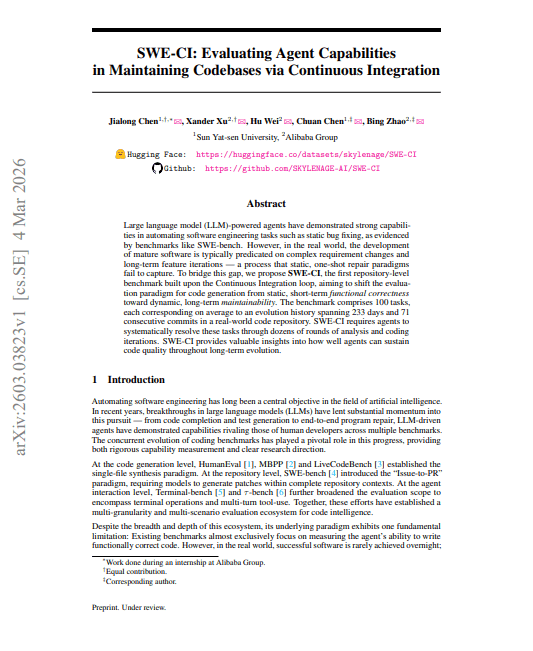
The result was brutal: Most models can write code that works today but almost none can maintain a system that continues to work tomorrow.
Seventy-five percent of the models broke previously working code during maintenance. Only Claude Opus 4 stayed above a 50% zero-regression rate. The rest accumulated regressions over time, slowly degrading the system with every iteration.
This shouldn’t surprise anyone who has built software at scale. We all know that writing code is the easy part whereas maintaining systems is the hard part.
Real software does not exist in a demo or a benchmark. It lives through hundreds of commits, shifting requirements, refactors, new dependencies, and constant evolution. The challenge is not making something work once. The challenge is making it survive change.
AI models today are largely optimized for the snapshot moment. That means: 1) You give them a prompt, 2) They generate code., 3)Tests pass and 4) Everyone is impressed.
But passing tests once is not the same as maintaining a codebase over time.
In real systems, every change interacts with everything that came before it. Small shortcuts compound. Fragile abstractions collapse under iteration. What looked elegant on day one becomes a maintenance burden by month six. Believe me, I’ve seen this several times.
The benchmark simply quantified what many engineers already suspect: AI can accelerate output, but that does not mean it improves the system.
And this is where the industry is about to experience a hangover.
Right now companies are measuring AI success using the easiest possible signals:
More code generated.
More pull requests opened.
Faster ticket resolution.
Higher velocity metrics.
These numbers look fantastic on a dashboard.
But they say almost nothing about whether the system is actually improving. They measure activity, not outcomes. They capture speed, not sustainability.
If AI increases output while quietly degrading maintainability, the pattern is predictable. You get a burst of productivity followed by months of slow erosion as complexity accumulates.
Anyone who has lived through a serious technical debt cycle has watched this movie before (it’s a scary one).
The difference now is that AI accelerates both sides of the equation. It can speed up progress, but it can also speed up the accumulation of mistakes.
That is why the real question of the AI era is not whether machines can write code. We already know they can.
The real question is what happens when humans and machines start building systems together.
Engineering teams are quietly becoming hybrid systems. Developers write part of the code. AI generates part of it. Tools suggest changes, refactors, and fixes. And Agents increasingly participate in the workflow, even manage parts of the workflows themselves.
The organization is no longer just coordinating people. It is coordinating humans and machines working inside the same codebase.
At that point intuition stops being enough.
Leaders need to understand what is actually happening inside the system. How AI is being used. Whether it improves delivery or introduces fragility. Whether it helps engineers produce better systems or simply produce more output.
Without that visibility, teams are flying blind.
Benchmarks like SWE-CI are a warning signal. They show that short-term success can easily hide long-term degradation. Code that works today can quietly become harder to maintain tomorrow.
In other words, the industry is optimizing for the wrong feedback loop.
The next phase of software development will require something different: Real signals about how work moves through engineering systems and how AI changes that dynamic over time.
Because once AI is deeply embedded in development workflows, understanding how it shapes performance becomes essential.
Otherwise the hangover arrives months later, when nobody remembers which shortcuts created the problem. Pensero helps teams understand how their engineering system is actually evolving. Because if AI is going to become a permanent collaborator in software development, organizations need a way to see how that collaboration is affecting the system.
Before the hangover arrives.