Why Fairness Scales Poorly Without Systems
The system leaders need so promotion, recognition, and performance don’t become political.

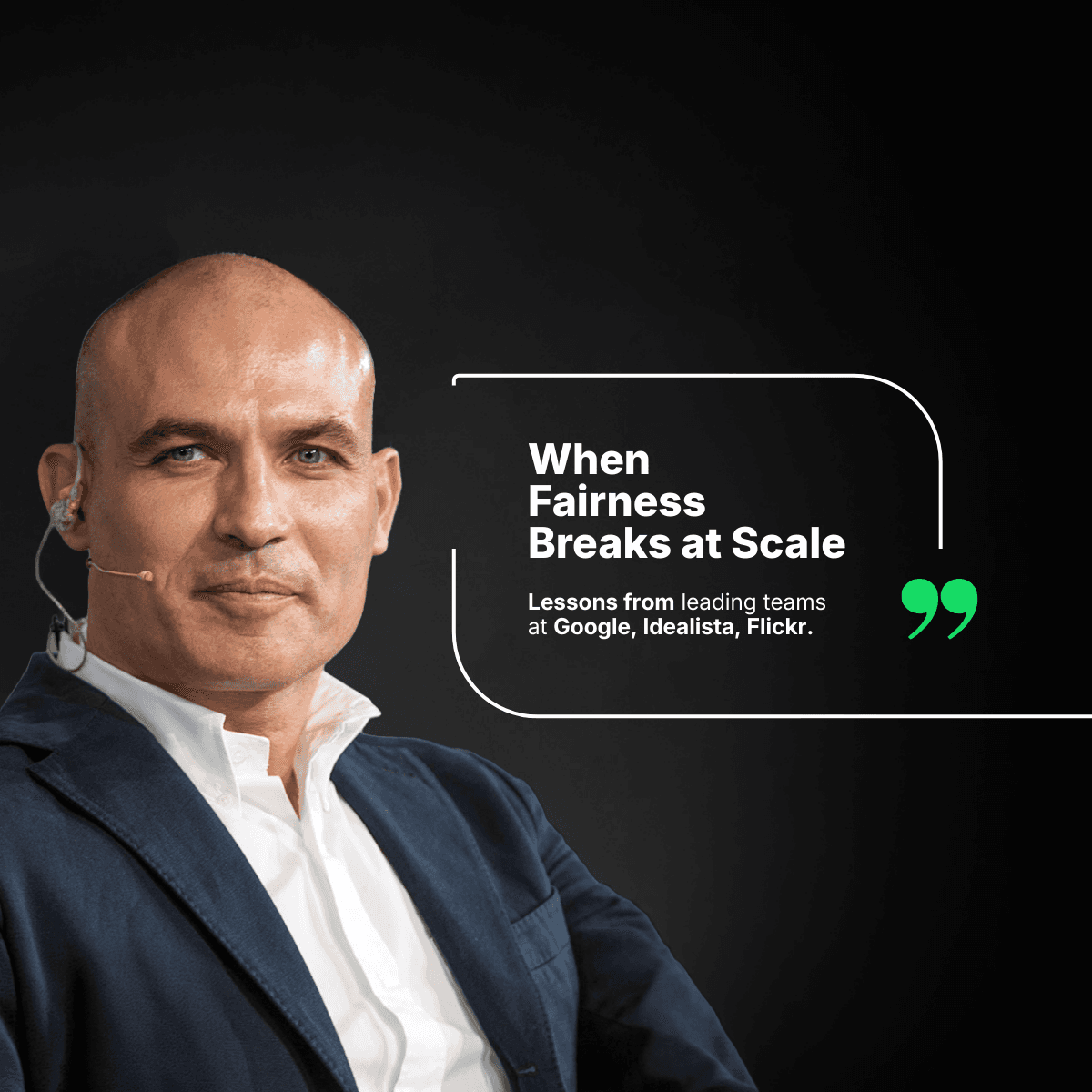
When I was acting CTO at Idealista (until we hired the one, who still leads the team today) and later while helping build Flickr, later Verse, and during my years managing large teams at Google, I saw the same pattern repeat.
In the early days, fairness feels natural: You’re close to the work, you know who solved the hard problem and you were in the room when the trade-offs were made.
At 5 people, context is shared.
At 50, it fragments.
At 500, fairness becomes a leadership liability.
At some point memory, proximity, and intuition stop being enough. No matter that you as a leader still care.
Fairness doesn’t disappear as you scale, it becomes harder to sustain without infrastructure.
Transparency Is Either Bidirectional Or It’s Not Real
When we talk about transparency, we don’t mean dashboards for executives.
We mean real bidirectionality from managers to IC and viceversa.
Leaders need visibility into how teams actually deliver beyond narratives, recency bias and beyond who presents best in a review.
But teams also need to understand how decisions about performance, promotions, and resourcing are made.
That mutual visibility is what makes fairness durable.
Without systems, fairness turns interpretative:
The loud contributor seems more impactful.
The last big launch overshadows six months of steady execution.
Promotion debates rely on advocacy, not evidence.
Engineering is the largest investment in most SaaS companies, here is where this becomes specially dangerous. Delivery is multi-dimensional: speed, complexity, reliability, collaboration, architectural quality, AI contribution.
If you reduce that to a few lagging indicators, subjectivity fills the gaps. What is really needed is to anchor reality to facts.
And shared reality is what prevents politics from replacing performance.
Fairness Is a Scaling Constraint
At scale, fairness cannot depend on good intentions, it needs a system that is truly bidirectional.
A system where leaders see how teams truly deliver across speed, complexity, reliability and collaboration. In a nutshell, teams need to understand how performance is evaluated and what decisions are made. That reciprocity is what creates real transparency.
Our goal building Pensero is to create a shared, observable context that allows everyone to be measured against the same reality. Not dashboards for control. Not metrics for pressure.
Because when transparency works both ways, something important happens:
High performers feel seen.
Coaching becomes continuous instead of episodic.
Promotion debates rely less on advocacy and more on evidence.
Excellence becomes cultural, not political.
And perhaps most importantly people want to work in that environment.
Hiring the best talent is your first goal. Maintaining and growing it needs to be the second. In my experience, talented engineers don’t leave because standards are high, they leave when standards feel inconsistent.
I’ve seen this dynamic at every stage of growth from startup to global scale. Fairness degrades quietly unless you design for it explicitly.
That is why I’m building what I’m building: to give organizations the structural transparency they need so fairness can survive scale and excellence can compound instead of erode.