AI IMPACT REPORT
Every dev team can see their AI adoption going up. Almost none can see what it changed underneath.
This is six months of continuous measurement of what actually happened to delivery, review, knowledge, and quality. Not a survey.
EXECUTIVE SUMMARY
AI changed the output number. Here’s what it changed underneath.
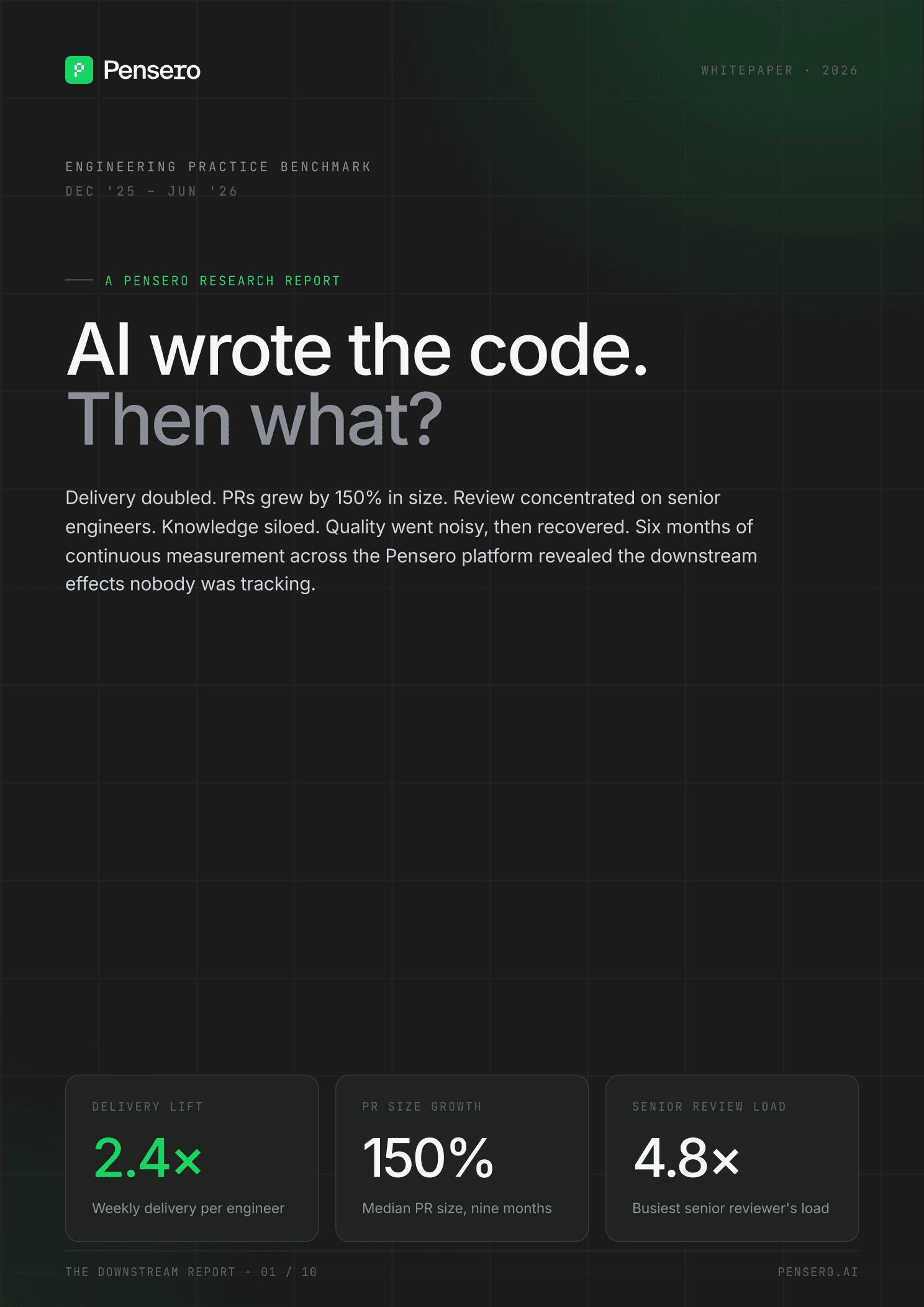
Delivery per engineer rose 2.4× in six months, with 94% of organizations growing. The same six months produced PRs that grew 150% in size, review load that concentrated on the senior engineers least able to absorb it, a 40% rise in single-owner code, and quality that went noisy before recovering. None of it shows up on an adoption dashboard.
01
AI adoption is not one thing: assisted coding, agent reviewers, agent-opened PRs. Three layers, three bets.
02
Delivery doubled, but the distribution stretched. The orgs ahead pull away at an increasing rate.
03
The bottleneck shifted. When writing got cheap, the unit of work expanded. Reading it didn’t.
04
Review couldn’t keep up. Load concentrated on the senior engineers least able to absorb it.
05
Knowledge siloed as a direct consequence. AI writes code; it doesn’t distribute ownership.
06
Quality went noisy, then recovered: the shape of a learning curve, not a collapse.
METHODOLOGY
Six months of continuous measurement across the Pensero platform: live work signals, not surveys or self-reports. A Pensero point is a unit of engineering contribution sized by magnitude × complexity, normalized per engineer per week.
PERIOD
Dec ’25 — Jun ’26
SAMPLE
Pensero platform panel
METHOD
Continuous measurement
METRIC
Pensero points / week / person
AUDIENCE
This research gives software engineering leaders an evidence-based view of what AI adoption actually changed - delivery, review load, knowledge distribution, and quality - so you can plan for the downstream effects before they become bottlenecks.