AI is increasing output, not necessarily performance.

Pensero turns AI activity into measurable impact by connecting cost to delivery, quality and efficiency, so leaders can make confident decisions.
  • No surveys
  • No surveillance
  • From work you already do
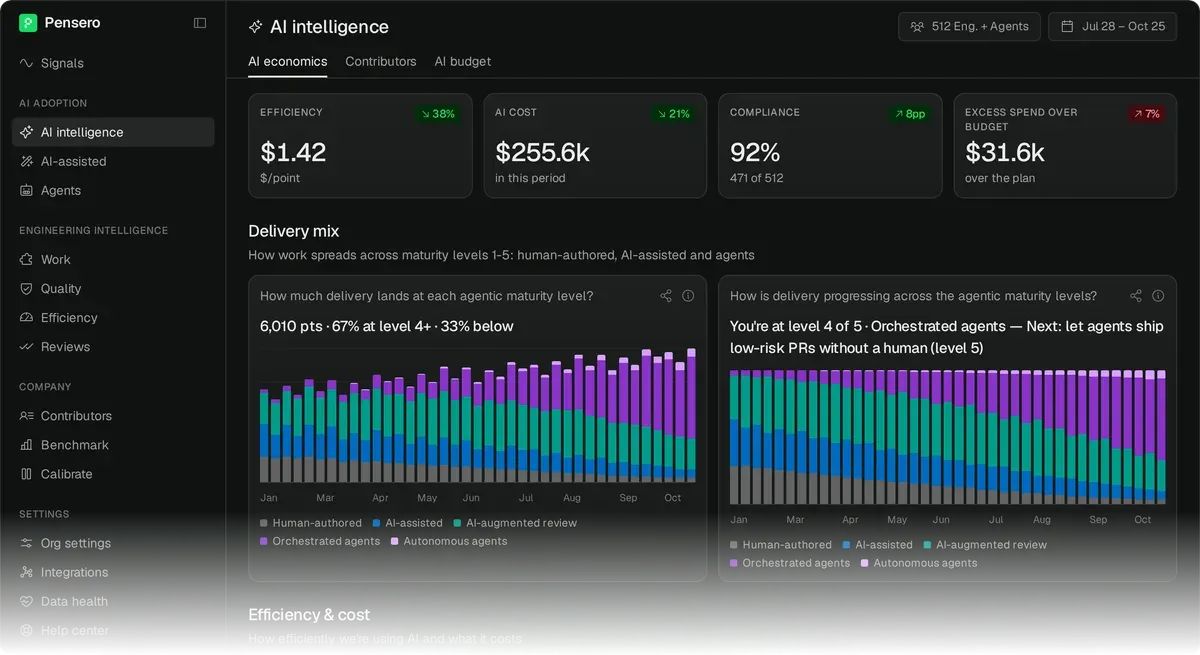
Pensero AI intelligence page with example data: AI cost per point, AI cost, compliance and spend over budget, then weekly delivery by agentic maturity level, from human-authored work to autonomous agents, the cost per point, the daily AI cost, AI and agent adoption, and the cost efficiency of each person.

Example reading. One customer workspace, last 90 days.

AI assisted
39%
of merged code
8pp adoption
Delivery lift
1.2x
more output shipped
22%
Quality tax
45.1%
of PRs reworked
13.2pp
Efficiency
7,891
tokens per point
34% worse
Extra AI cost
$350K
projected this year
4.6x

Engineering teams already measuring with Pensero

Why Pensero is different

Is AI making your business better in a way you can prove?

Activity · what most teams measure

Visibility into usage, not impact.

  • Self-reported surveys
  • Generic industry reports
  • Vanity metrics ( PRs, deploys, activity)

Counts effort. Says nothing about whether it paid off.

Performance · what Pensero measures

A clear, objective view of ROI.

  • Real production data
  • Complexity-weighted delivery
  • Actual engineering outcomes

Ties cost to delivery, quality and efficiency.
The questions leaders actually ask.

The product

How Pensero measures AI impact

  1. 01 Adoption

    See how much AIyour team really uses

    Adoption is more than seat counts. Pensero measures how much merged code is AI assisted and how many developers genuinely rely on AI tools.

    We measure

    • Share of merged code that is AI assisted
    • Active developers using AI tools
    • Adoption trend, month over month
    • Your numbers against global benchmarks

    No surveys. Adoption is read directly from the work, then compared to real peers.
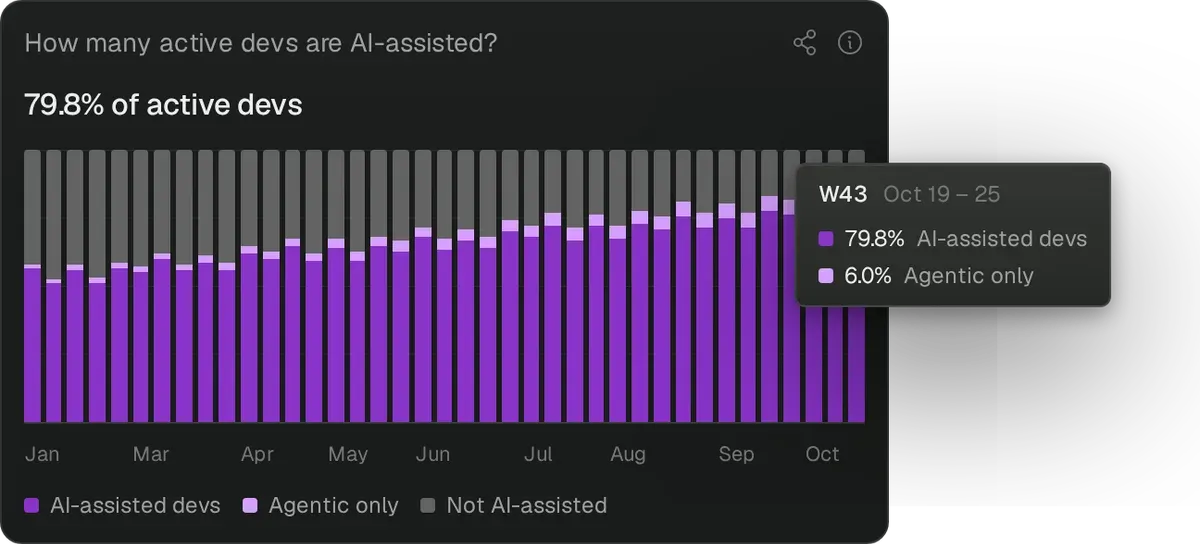
    Pensero AI adoption chart with example data: 79.8% of active developers are AI-assisted this week, up from 56% in January.
  2. 02 Impact on delivery & quality

    Connect AI usageto what you ship

    More output is not the same as better output. Pensero shows whether AI is lifting delivery, and what it costs you in rework.

    We connect

    • PR delivery trend as adoption rises
    • Delivery lift, isolated from headcount
    • Quality tax: the share of PRs reworked
    • Out-of-office adjusted, so trends are real

    The same view that shows a 1.2× lift also surfaces the rework it created.
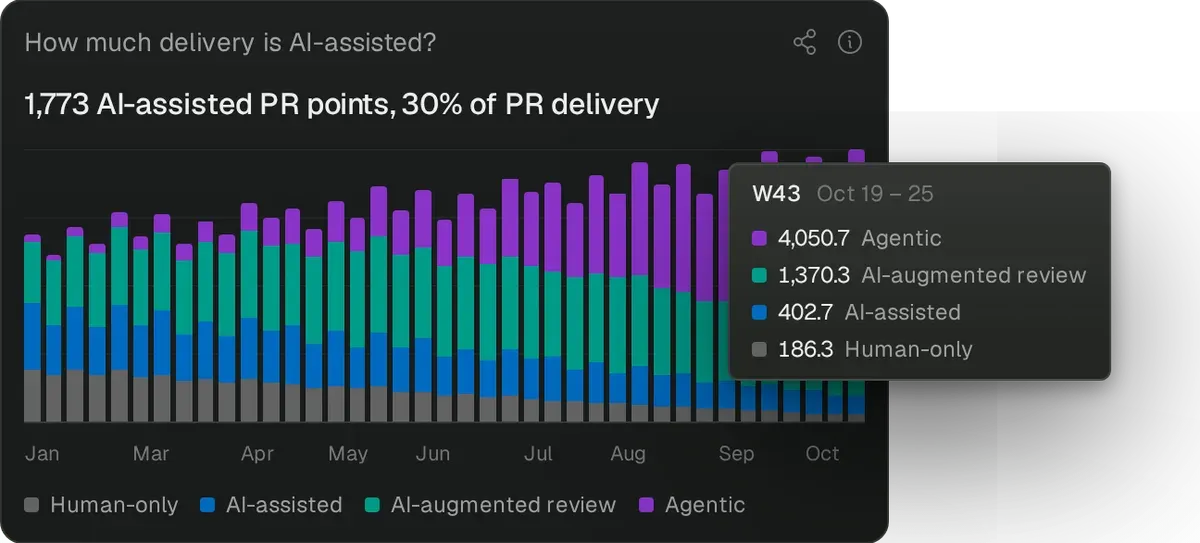
    Pensero AI delivery chart with example data: weekly PR delivery points split into human-only, AI-assisted, AI-augmented review and agentic work. Agentic work grows from a small share in January to most of the delivery in October.
  3. 03 Efficiency & cost

    Tokens per pointfuel economy for AI

    Like litres per 100 km: the more tokens it burns to ship one delivery point, the worse the mileage. Right now it is climbing.

    We track

    • Tokens per delivery point, over time
    • Daily AI spend, one square per day
    • Projected annual extra cost
    • Spend mapped to output, not raw usage

    Cost is tied to delivery, so you can see efficiency degrade before the bill does.
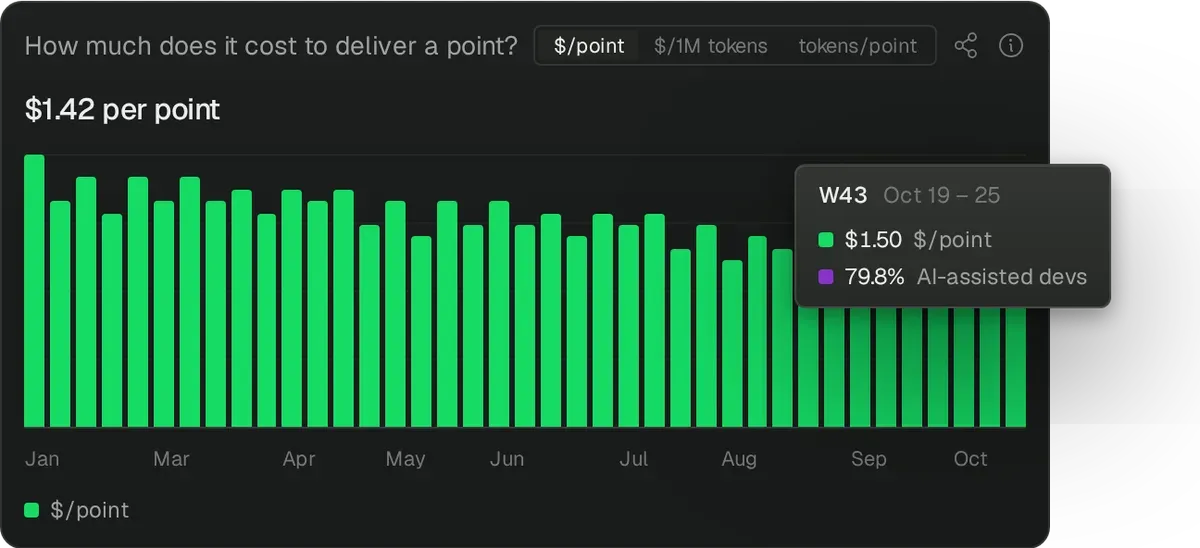
    Pensero AI efficiency chart with example data: AI costs $1.42 per delivery point this period, down from $2.30 in January, while 79.8% of active developers are AI-assisted.
  4. 04 Who's getting value

    Spot your high-leveragedevelopers

    Tokens per delivery point, mapped across your team.

    We surface

    • Efficiency distribution across developers
    • High-leverage developers, by name
    • Coaching opportunities, made visible
    • Delivery × efficiency, in four quadrants

    Distributions are framed for coaching and enablement, not ranking individuals against each other.
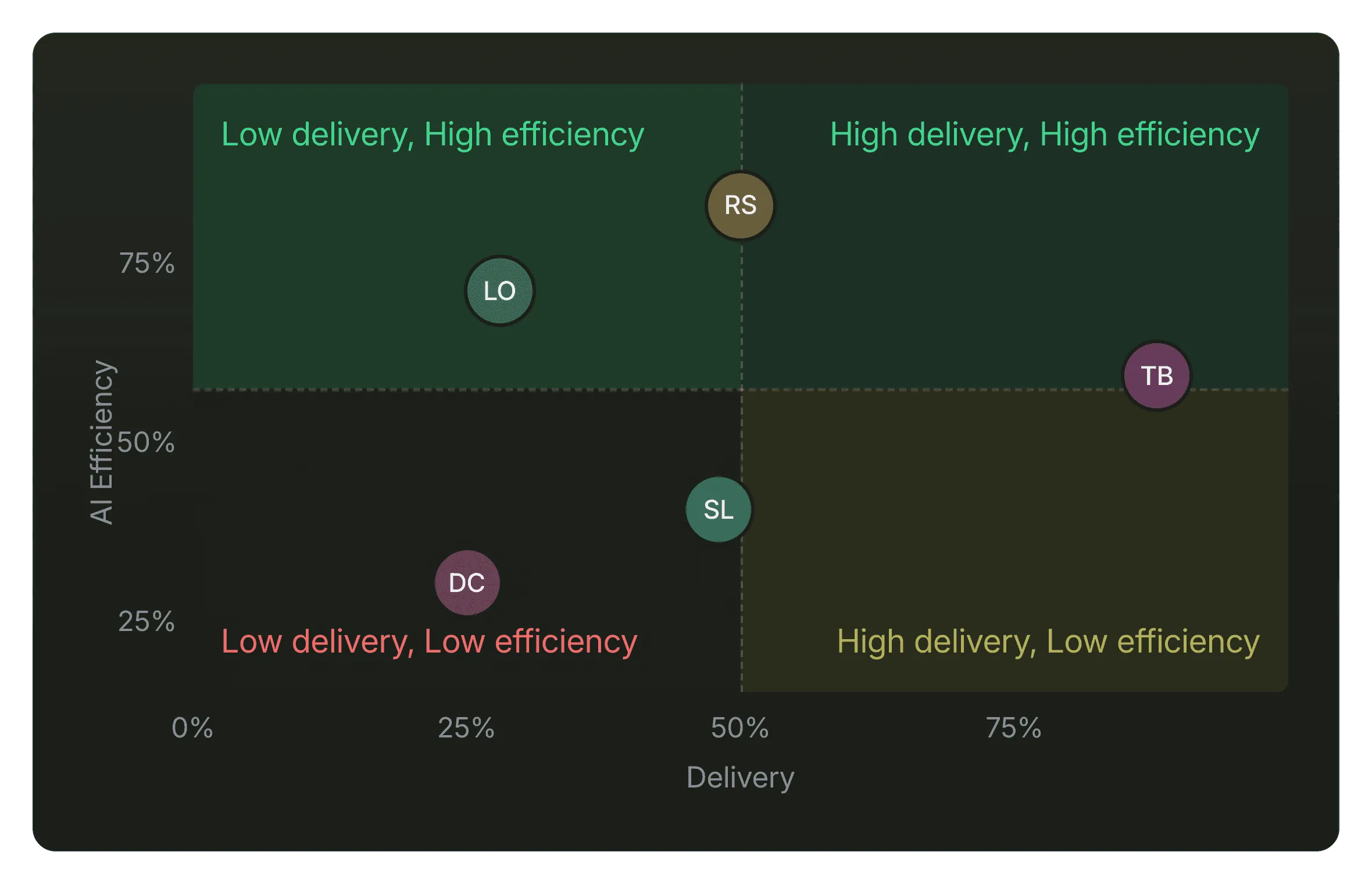
    Pensero chart with example data: one dot per developer, placed by delivery and AI efficiency, in four quadrants from low delivery and low efficiency to high delivery and high efficiency.
  5. 05 Usage breakdown

    Know which tools andmodels drive delivery

    Pensero maps every assistant and model in your stack to the delivery it actually produces, so tool decisions are grounded in impact.

    We break down

    • Tool mix over time, by share of AI delivery
    • Model mix across every assistant
    • Where adoption is concentrating
    • Trends as your stack evolves

    Renegotiate, consolidate, or double down, with evidence instead of vendor decks.
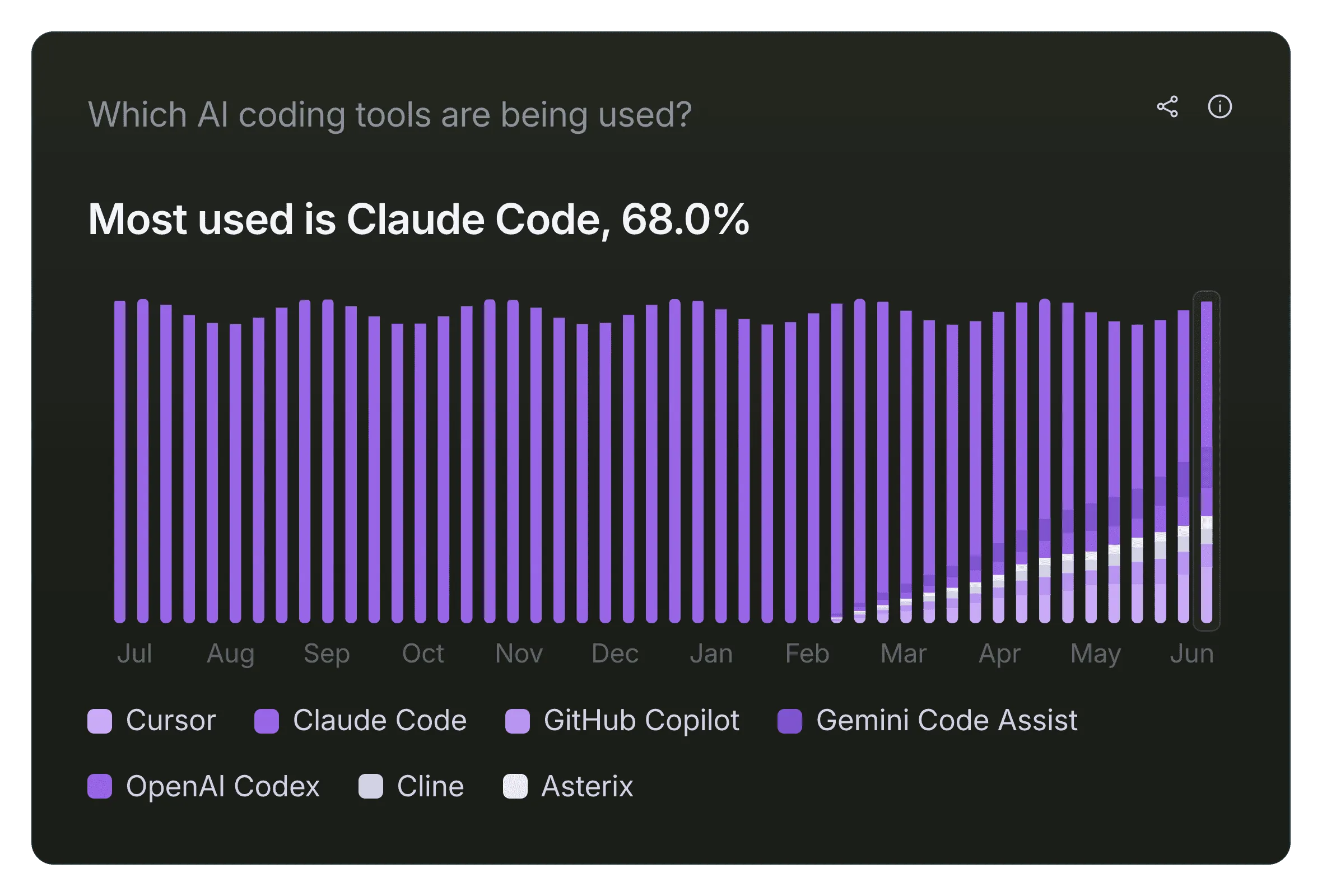
    Pensero chart with example data: which AI coding tools are used, week by week from July to June. The most used is Claude Code, at 68.0%, then Cursor, GitHub Copilot, Gemini Code Assist, OpenAI Codex, Cline and Asterix.

Why Pensero

Built for teams that can't compromise on trust

  • Built on real engineering work

    Signals from code, tickets and planning tools, translated into execution insight, not self-reported activity.

  • Designed for scaled SaaS

    Created by former CTOs who have built and scaled complex software organizations through real growth.

  • Aligned across functions

    A shared execution language for engineering, finance and leadership, grounded in global talent benchmarks.

At a glance

Proven at scale

of datapoints processed
Billions
developers on the platform
5k+
onboarding to first value
15′
increase in performance
30%

Trust and compliance, by design

Designed to meet strict SOC 2 Type II standards, follows GDPR principles to protect personal data, and supports HIPAA requirements for sensitive information.

  • Secured by Sprinto: SOC 2
  • Secured by Sprinto: GDPR
  • Secured by Sprinto: HIPAA
  • “We need a way that is objective to see that we’re increasing productivity.”
    Jordi AbadCTO, SEAT CODERead story →
  • “With Pensero we go 4x faster.”
    Andrew EyeCEO and Founder, ClosedLoopRead story →
  • “Until Pensero, that visibility did not exist.”
    Raul GómezVP of Technology, ExoticcaRead story →
  • “Now we went from 70% to 30% maintenance… it’s where we want it to be.”
    Ignasi VegasCEO and Co-founder, CubboRead story →
  • “I go every morning into the email, check the first KPIs and drill down.”
    Jordi MiróCTO, ZynapRead story →

How it works

Get started in minutes. See insights in hours.

Connect your stack. See months of history from day one.

  1. 1 hour

    Connect & Structure

    Integrates repositories, tickets and messages automatically so AI can break work into measurable units, giving your team a unified, transparent view of everything delivered.

  2. 1 day

    Analyze & Detect

    Surface delivery vs roadmap gaps, AI contribution patterns, and execution insights so bottlenecks and early performance drag become visible through evidence-based reviews.

  3. 1 week

    Report & Decide

    Establish a single source of execution truth with team-level and AI vs human performance comparisons, enabling board-ready reporting and confident, scalable capital decisions.