The new transaction layer for IT outsourcing
Sell software delivery, not engineering hours
When agents write the code, hours stop measuring value. Pensero scores the work in delivery points, so your firm can price, prove and bill it.
Some of the world’s best engineering teams are already using Pensero


Problem
Every outsourced team is going full agentic. The market still sells capacity.
AI is breaking the link between hours and output.
The 5 levels of the agentic journey
- of merged code is AI-written in top-quintile organizations, up from 31% a quarter earlier
- 48%
- Billed by the hour, the buyer does not see that gain.
- output gap per engineer between top and typical teams
- 2.8x
- An hour no longer predicts what it buys.
- of IT services contracts are expected to be outcome-based by 2029, according to IDC
- 30%
- That only works when delivery can be measured and agreed.
Pensero benchmark, 200+ organizations, Q2–Q3 2026. IDC FutureScape: Worldwide Services 2026, Dec 2025.
Solution
The delivery point. One unit of finished work.
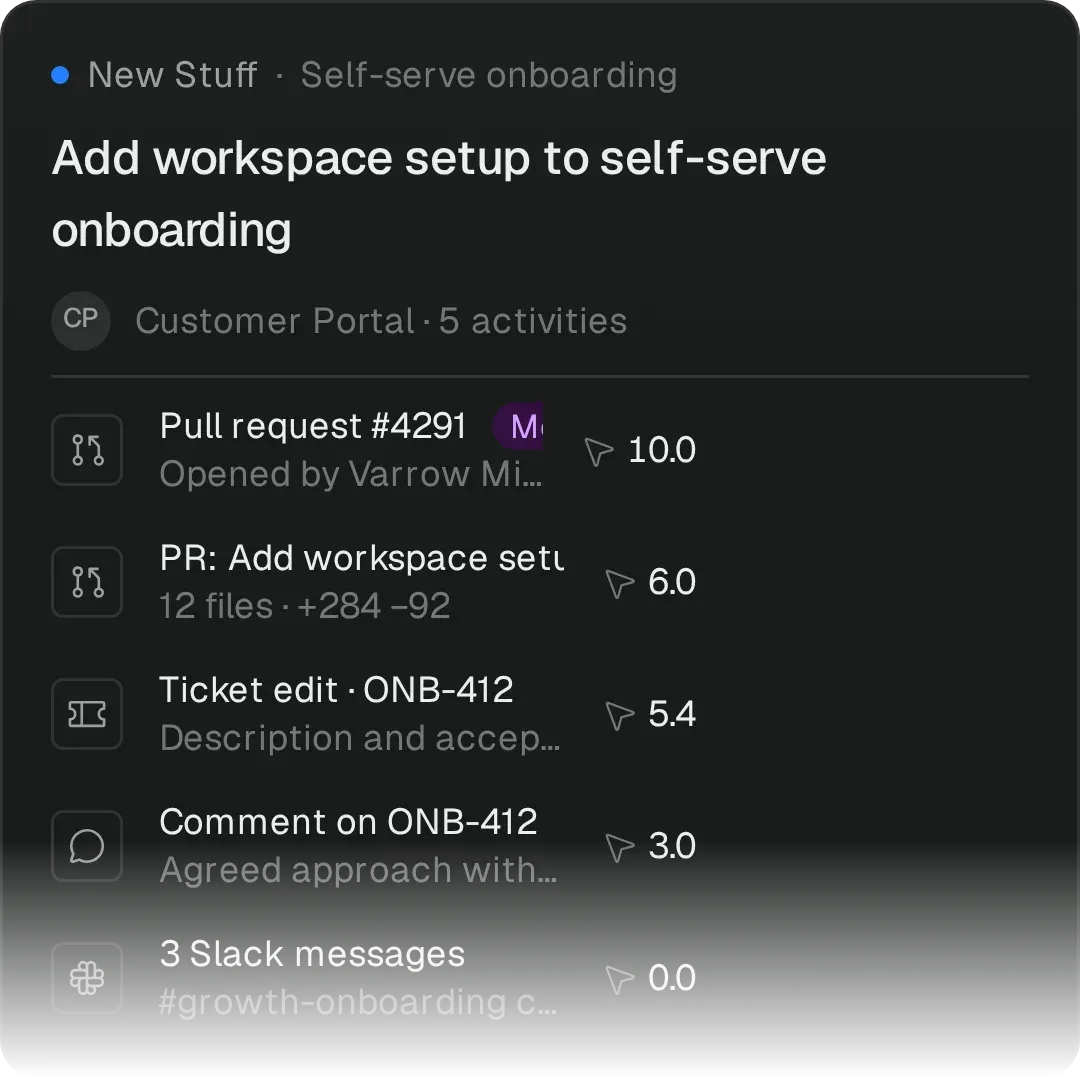
Pensero scores every pull request and ticket by size and difficulty, the same way for people, vendors and agents. A small fix is 3 points, a cross-system feature 24.
Points measure contribution, not price: your firm sets the price per point.
- Pull request #4291MergedOpened by Varrow Migration Agent for Customer Portal10.0
- PR: Add workspace setup step12 files · +284 −926.0
- Ticket edit · ONB-412Description and acceptance updated5.4
- Comment on ONB-412Agreed approach with the Growth team3.0
- 3 Slack messages#growth-onboarding channel0.0
Comprehensive
Nothing is out of scope.
PRs, reviews, tickets, docs and agent sessions all count.
Scientific
Understood, not counted.
Agents read each piece of work: magnitude net of boilerplate × complexity. Humans disagree with the score in fewer than 0.5% of items.
Accurate
Normalized at scale.
Calibrated on 200+ organizations and 2M+ PRs and tickets: the same change earns the same points in any stack.
Unbiased
Gaming does not pay.
Scores the task, not the person. Boilerplate, reverts and duplicates earn zero.
Scored at scale, so one point means the same thing everywhere.
- organizations benchmarked
- 200+
- developers measured
- 6,000+
- PRs and tickets scored
- 2M+
- data points scored
- 10M
Pensero, Sep 2026.
Your firm sells delivery, not hours. Pensero certifies it.
Agents cut the hours a project needs, so a firm that bills hours loses revenue as it adopts AI. Priced per delivery point, the firm keeps the gain from every point it ships.
Score the client’s teams
Your firm
Baselines every team: what agents deliver today, what is possible, and the client’s cost per delivery point.
Pensero
Connects the client’s systems, in the cloud or on-prem, then captures code, tickets, docs, agent sessions and tokens, and scores them.
Quote in delivery points
Your firm
Designs the agentic workflow and prices the work per delivery point instead of per day.
Pensero
The 200+ organization benchmark makes the quote comparable and credible.
Build and ship the work
Your firm
Builds verification gates, review harnesses and CI for agents, and ships with its own people and agents.
Pensero
Scores every PR and ticket as it happens, in delivery points.
Show the evidence
Your firm
Shares with the client what shipped, at what quality, with how much rework and token spend, before acceptance.
Pensero
Delivers the verification evidence and token spend inside the workflow, through MCP.
Get paid on acceptance
Your firm
Bills accepted delivery points. The client’s CFO sees one unit across every vendor.
Pensero
Measures what held, so the firm’s track record compounds.
Integration is one step: connect the client’s systems
Pensero reads GitHub, GitLab, Jira, Linear, Copilot, Cursor, Claude Code and Devin, including contractors with repo access. It runs in Pensero Cloud, in the EU, in the client’s cloud or on-prem. The client’s teams change nothing.
Explore all integrations →- GitHub
- GitLab
- Bitbucket
- Azure DevOps
- GitHub Copilot
- Cursor
- Claude Code
- Gemini Code Assist
- OpenAI Codex
- LiteLLM
- Devin
- SonarQube
- Jira
- Linear
- YouTrack
- GitHub Projects
- Confluence
- Notion
- Google Drive
- Slack
- Microsoft Teams
- Google Chat
- Google Calendar
- Microsoft 365 Calendar
- Okta







Everyone else sells inputs or measures activity. Only Pensero certifies accepted delivery.
Coding agents and metrics tools measure their own activity. Marketplaces and procurement tools sell hours, seats and usage. Pensero scores accepted delivery points as a neutral operator: one unit across people, vendors and agents.
- Captures the whole workflow: code, tickets, docs, agents, tokens.
- One unit, calibrated on 200+ organizations and 2M+ PRs and tickets.
- Acts inside the workflow: 80% of traffic through MCP.
- Does not deliver the work, so no vendor grades its own return.
- Rules both sides rely on: acceptance and dispute.
Validation
Some of the best consulting firms are partnering with Pensero. Corporations are sharing the benefits of agentic transformation.
A real-world example: a 1,500-engineer client delivered 37% more in 3 months.
A US conglomerate with 53 organizations never had a consolidated view before. With delivery points it got one comparable unit across all 53 entities.
Customer result
A 1,500-engineer enterprise, 3 months after Pensero
US conglomerate · 1,500 engineers · 53 entities · 3 months with Pensero
- more work delivered
- +37%
- more per engineer
- +35%
- more code written by AI
- 2.5x
Pensero client data · 156.3K delivery points · 11.2 points per engineer per week · 45% AI-written code.
Questions from partner firms
What is a delivery point?
A delivery point is one unit of finished work, scored by size and difficulty: points = magnitude × complexity. Pensero scores every pull request and ticket the same way for people, vendors and agents, and traces each point to the pull request and ticket behind it.
How does Pensero score a task?
Magnitude runs from XXS (0.15) to XL (8). Complexity runs from 1.0 to 3.0 across code, system design, delivery, communication and ownership. A small fix scores 3.0 points, a cross-system feature 24. The scale is calibrated on 2M+ pull requests and tickets from 200+ organizations.
Who sets the price per delivery point?
Your firm does. The delivery point measures contribution, not price, so each provider quotes its own price per point and competes on price, quality and reliability.
How does my firm quote and get paid?
You quote the project in points and a price per point. As the work ships, Pensero scores it and shows the client the evidence: what shipped, at what quality, with how much rework and token spend. You bill the accepted points.
What does the client see?
One unit across every vendor and its own teams. The client compares your delivery points, quality and rework with any other provider at the same price per point, in the same report.
Does Pensero deliver the work?
No. Your firm delivers the work with its people and agents. Pensero only measures it, so no vendor grades its own work.
Can a team game the score?
Gaming does not pay. Pensero scores the task, not the person, and boilerplate, reverts and duplicates earn zero. The same change earns the same points in any stack.
What does Pensero need from the client?
Read access to the systems the teams already use: GitHub, GitLab, Jira, Linear, Copilot, Cursor, Claude Code and Devin, including contractors with repo access. Nobody changes how they work.
Where does Pensero run at the client?
In Pensero Cloud, in an EU-based deployment, in the client’s own cloud account or on-premises. Integration is one step: connect the systems.
Is the marketplace live?
Measurement is live today: scoring, evidence and the benchmark. Proposal evaluation, contracting and settlement on the marketplace are in build.