Head-to-Head
Pensero vs DX
Same problem. Different approach.
Engineering performance matters. DX helps you understand how engineers feel about their work. Pensero helps you understand what actually happened in your systems.
How do they differ?
DX and Pensero solve adjacent but fundamentally different problems.
DX gives visibility into developer experience. Pensero gives visibility into engineering performance.
| Feature | Pensero | DX |
|---|---|---|
| AI adoption and usage trackingDX blends surveys with usage data; Pensero reads delivered work | Yes | Yes |
| AI spend and token cost tracking | Yes | No |
| Delivered output weighted for size and complexity | Yes | No |
| Humans, AI-assisted engineers and agents on one scale | Yes | No |
| Cost per unit of delivered work | Yes | No |
| Cross-company benchmarksDX benchmarks productivity; Pensero benchmarks delivered value | Yes | Yes |
| Next moves pinpointed from your dataDX suggests adoption practices; Pensero says which work moves to agents | Yes | Yes |
| Level on the 5 levels, measured from delivery data | Yes | No |
| Forward-deployed engineers and transformation program | Yes | No |
What is the core difference between Pensero and DX?
Pensero measures engineering performance through objective delivery evidence — code, tickets, documents and workflow data. DX centers on developer experience and sentiment, gathered primarily through surveys. If you need to know what actually happened in your systems, not just how developers feel about it, Pensero is the better fit.
Does Pensero use developer surveys like DX?
No. Pensero's core measurement model runs on delivery artifacts, workflow complexity, quality signals, and AI contribution data, no surveys required. It can sit alongside a sentiment program if you run one, but it doesn't depend on self-reported input to function.
Which platform is better for performance reviews and calibration?
Pensero is built for calibration workflows and team benchmarking, grounding performance conversations in measurable execution outcomes rather than manager impression alone.
Can DX show the business value of AI-assisted engineering work?
DX has recently added AI code tracking by commit and PR. Pensero's approach goes a step further by separating human, AI-augmented, and agent-generated contribution, then connecting that to delivery value, defect impact, and cost, so leaders can see not just how much AI-assisted code shipped, but whether it actually helped.
How quickly can we start seeing useful data with Pensero?
Most teams connect core tools in about an hour, see early insights in one day, and establish board-ready reporting in about a week. Historical data is available from day one after connecting your stack.
Is Pensero only for engineering managers?
No. Pensero supports engineering leaders, finance stakeholders, and executives who need objective visibility for planning, benchmarking, capitalization reporting, and strategic decision-making.
Engineering teams already measuring with Pensero


“And the best part: it was truly plug-and-play — we were live in just one day.”
Jean-François LegourdCo-founder, Elfie 
“Pensero gives me daily peace of mind.”
Jose-Luis VilarCo-founder and CPTO, Caravelo 
“With Pensero we go 4x faster.”
Andrew EyeCEO and Founder, ClosedLoopRead story → 
“Finally a tool that truly increases velocity.”
Nick TraylorHead of Engineering, StordRead story → 
“Pensero is my compass for knowing where the team is headed.”
Jordi MiróCTO, ZynapRead story →
Pensero proves engineering value and AI impact
Objective visibility into every engineering contribution.
AI Transformation
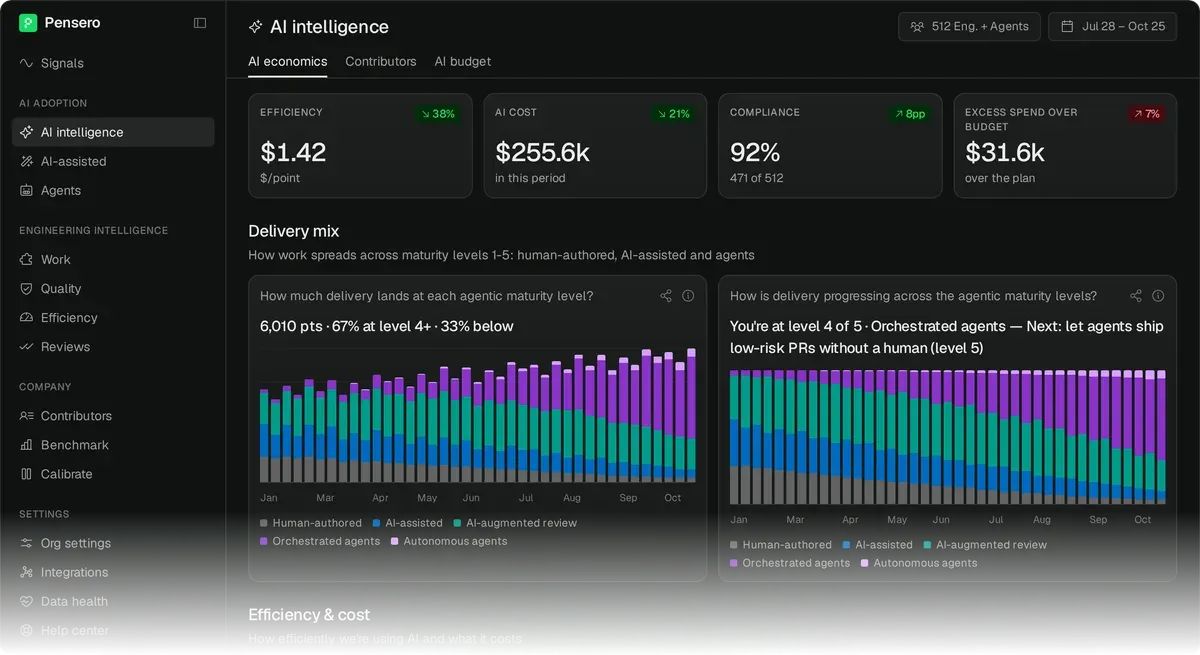
Track AI adoption, productivity impact, quality outcomes, and cost efficiency to prove the true business value of AI across engineering teams.
Learn more →Delivery Intelligence
Provides real-time visibility into engineering output, delivery flow, and strategic alignment to ensure teams are shipping high-value work efficiently and without bottlenecks.
Learn more →Talent & Benchmarking
Uses objective performance data and industry benchmarks to evaluate teams, compare cohorts, and support better talent and leadership decisions.
Learn more →Code Quality
Measures code health, review effectiveness, defect trends, and technical debt to improve software quality and maintain strong engineering standards.
Learn more →Financial Reporting
Delivers finance-ready engineering reports that track CapEx, R&D capitalization, and project cost allocation for audit compliance and executive decision-making.
Learn more →
- Human-authored
- AI-assisted
- AI-augmented review
- Orchestrated agents
- Autonomous agents
- Human-authored
- AI-assisted
- AI-augmented review
- Orchestrated agents
- Autonomous agents
- AI-assisted cost
- Agentic cost
- No usage
- Included in plan
- Low
- Moderate
- High
- Very high
- AI-assisted devs
- Agentic only
- Not AI-assisted
- Agentic users
- Non-agentic users
Pensero integrations
Go beyond code: understanding performance requires a 360° assessment
Your entire delivery stack, translated into comparable signals.
Explore all integrations →- GitHub
- GitLab
- Bitbucket
- Azure DevOps
- GitHub Copilot
- Cursor
- Claude Code
- Gemini Code Assist
- OpenAI Codex
- LiteLLM
- Devin
- SonarQube
- Jira
- Linear
- YouTrack
- GitHub Projects
- Confluence
- Notion
- Google Drive
- Slack
- Microsoft Teams
- Google Chat
- Google Calendar
- Microsoft 365 Calendar
- Okta







How it works
Get started in minutes. See insights in hours.
Connect your stack. See months of history from day one.
1 hour
Connect & Structure
Integrates repositories, tickets and messages automatically so AI can break work into measurable units, giving your team a unified, transparent view of everything delivered.
1 day
Analyze & Detect
Surface delivery vs roadmap gaps, AI contribution patterns, and execution insights so bottlenecks and early performance drag become visible through evidence-based reviews.
1 week
Report & Decide
Establish a single source of execution truth with team-level and AI vs human performance comparisons, enabling board-ready reporting and confident, scalable capital decisions.