Head-to-Head
Pensero vs Span
Pensero gives leaders objective visibility into how engineering teams actually perform so they can make high-stakes decisions with confidence.
How do they differ?
Span and Pensero solve adjacent but fundamentally different problems.
Span measures activity while Pensero focuses on understanding the complexity and magnitude of the problem behind your code.
| Feature | Pensero | Span |
|---|---|---|
| AI adoption and usage trackingSpan traces AI sessions; Pensero measures all delivered work | Yes | Yes |
| AI spend and token cost trackingSpan tracks token spend; Pensero shows cost per delivered point | Yes | Yes |
| Delivered output weighted for size and complexity | Yes | No |
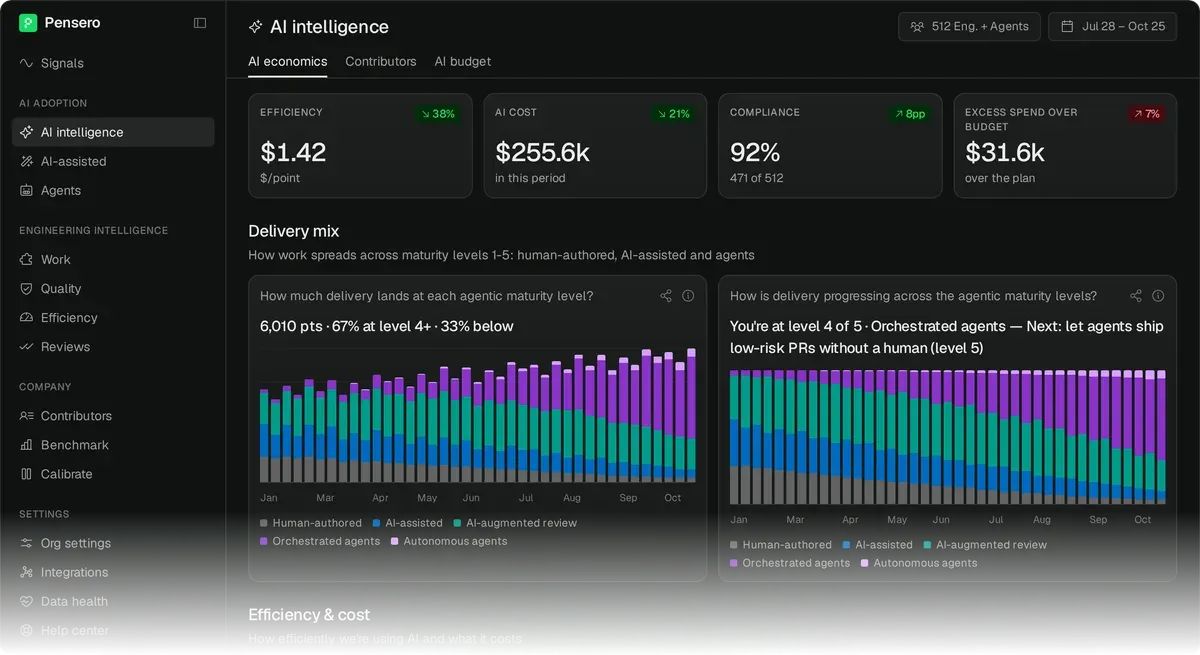
| Humans, AI-assisted engineers and agents on one scale | Yes | No |
| Cost per unit of delivered work | Yes | No |
| Cross-company benchmarks | Yes | No |
| Next moves pinpointed from your dataSpan flags effective AI work; Pensero pinpoints the next level move | Yes | Yes |
| Level on the 5 levels, measured from delivery data | Yes | No |
| Forward-deployed engineers and transformation program | Yes | No |
How is Pensero different from Span?
Both are AI-native platforms measuring delivery and AI impact — this isn't a category mismatch. The difference is emphasis: Span leans into agent-trace-level observability (what happened inside the AI session) and automated cost capitalization. Pensero leans into complexity-weighted scoring of the work itself and calibration-ready performance data for leadership and talent decisions.
Can Pensero inform headcount and hiring decisions?
Yes. Objective performance and complexity data supports better hiring, allocation, and org-design decisions — though this isn't unique to Pensero; Span's allocation module does similar work by classifying effort against priorities.
Why does complexity-weighted measurement matter?
Not all shipped work is equally hard, and AI has widened that gap — high volume no longer means high value. Pensero normalizes for complexity so leaders aren't rewarding output for output's sake.
Can Pensero support both team-level and individual-level calibration?
Yes. Pensero supports team benchmarking and individual calibration to improve consistency in evaluations, growth discussions, and promotion readiness.
Does Pensero cover AI productivity impact?
Yes. Pensero tracks AI adoption and links it to delivery outcomes, helping teams understand whether AI is improving execution quality and speed in practice.
Is Pensero only for mature enterprises?
No. Pensero is useful for scaling teams and growth-stage companies that need fast visibility and stronger execution discipline without heavy implementation overhead.
Engineering teams already measuring with Pensero


“And the best part: it was truly plug-and-play — we were live in just one day.”
Jean-François LegourdCo-founder, Elfie 
“Pensero gives me daily peace of mind.”
Jose-Luis VilarCo-founder and CPTO, Caravelo 
“With Pensero we go 4x faster.”
Andrew EyeCEO and Founder, ClosedLoopRead story → 
“Finally a tool that truly increases velocity.”
Nick TraylorHead of Engineering, StordRead story → 
“Pensero is my compass for knowing where the team is headed.”
Jordi MiróCTO, ZynapRead story →
Pensero proves engineering value and AI impact
Objective visibility into every engineering contribution.
AI Transformation
Track AI adoption, productivity impact, quality outcomes, and cost efficiency to prove the true business value of AI across engineering teams.
Learn more →Delivery Intelligence
Provides real-time visibility into engineering output, delivery flow, and strategic alignment to ensure teams are shipping high-value work efficiently and without bottlenecks.
Learn more →Talent & Benchmarking
Uses objective performance data and industry benchmarks to evaluate teams, compare cohorts, and support better talent and leadership decisions.
Learn more →Code Quality
Measures code health, review effectiveness, defect trends, and technical debt to improve software quality and maintain strong engineering standards.
Learn more →Financial Reporting
Delivers finance-ready engineering reports that track CapEx, R&D capitalization, and project cost allocation for audit compliance and executive decision-making.
Learn more →
- Human-authored
- AI-assisted
- AI-augmented review
- Orchestrated agents
- Autonomous agents
- Human-authored
- AI-assisted
- AI-augmented review
- Orchestrated agents
- Autonomous agents
- AI-assisted cost
- Agentic cost
- No usage
- Included in plan
- Low
- Moderate
- High
- Very high
- AI-assisted devs
- Agentic only
- Not AI-assisted
- Agentic users
- Non-agentic users
Pensero integrations
Go beyond code: understanding performance requires a 360° assessment
Your entire delivery stack, translated into comparable signals.
Explore all integrations →- GitHub
- GitLab
- Bitbucket
- Azure DevOps
- GitHub Copilot
- Cursor
- Claude Code
- Gemini Code Assist
- OpenAI Codex
- LiteLLM
- Devin
- SonarQube
- Jira
- Linear
- YouTrack
- GitHub Projects
- Confluence
- Notion
- Google Drive
- Slack
- Microsoft Teams
- Google Chat
- Google Calendar
- Microsoft 365 Calendar
- Okta







How it works
Get started in minutes. See insights in hours.
Connect your stack. See months of history from day one.
1 hour
Connect & Structure
Integrates repositories, tickets and messages automatically so AI can break work into measurable units, giving your team a unified, transparent view of everything delivered.
1 day
Analyze & Detect
Surface delivery vs roadmap gaps, AI contribution patterns, and execution insights so bottlenecks and early performance drag become visible through evidence-based reviews.
1 week
Report & Decide
Establish a single source of execution truth with team-level and AI vs human performance comparisons, enabling board-ready reporting and confident, scalable capital decisions.