Session output
Session cost by output type · Last 14 days
$246 · 11 sessions
PR · 6$171
Doc · 2$12
Research · 1$18
Ops · 1$21
Nothing · 1$24
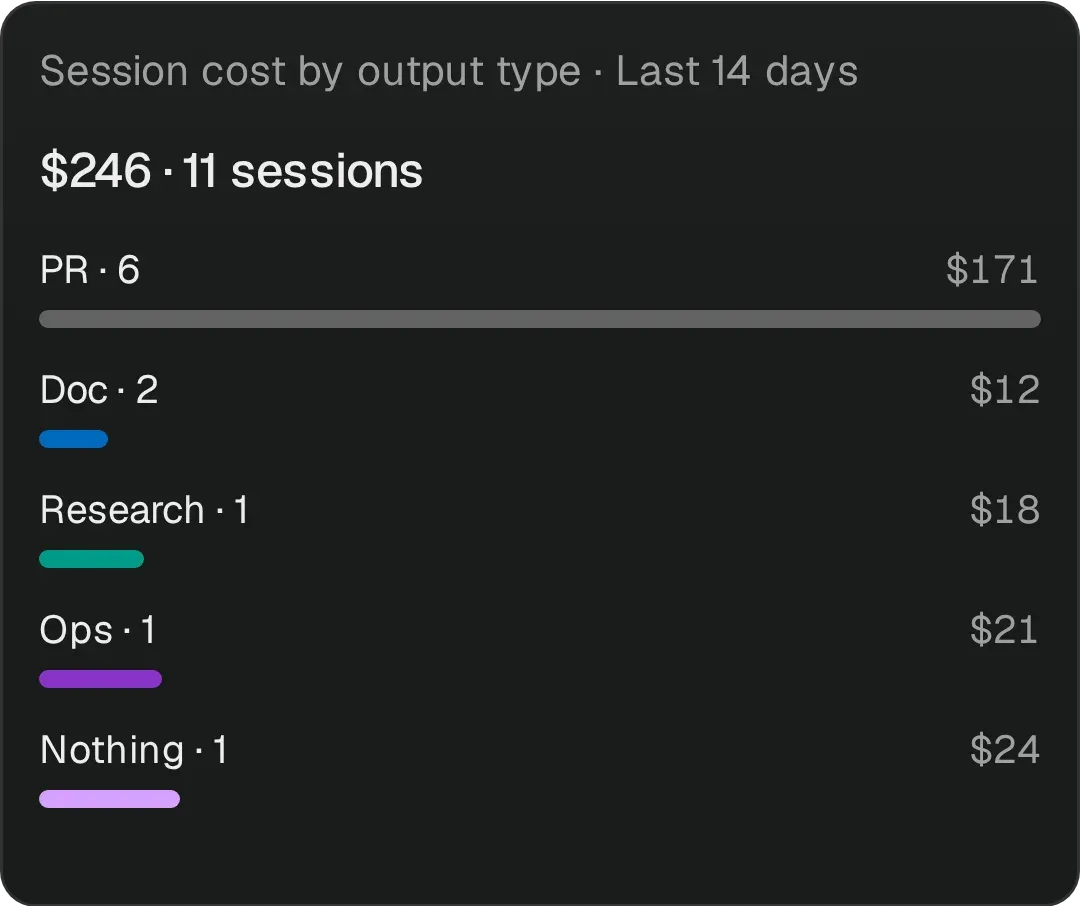
See where agent spend goes
Compare session cost by output type before you change how a team works.
Pensero Agent Traffic Control
Measure the cost per delivered point for each owner. Pensero keeps premium models where they deliver and routes the others to lower-cost models.
↓ requests
↓ pass, or route premium → lower-cost model
Your model provider
Routed: $/pt above target, with enough PR delivery
Session output
Compare session cost by output type before you change how a team works.
Cost and delivery
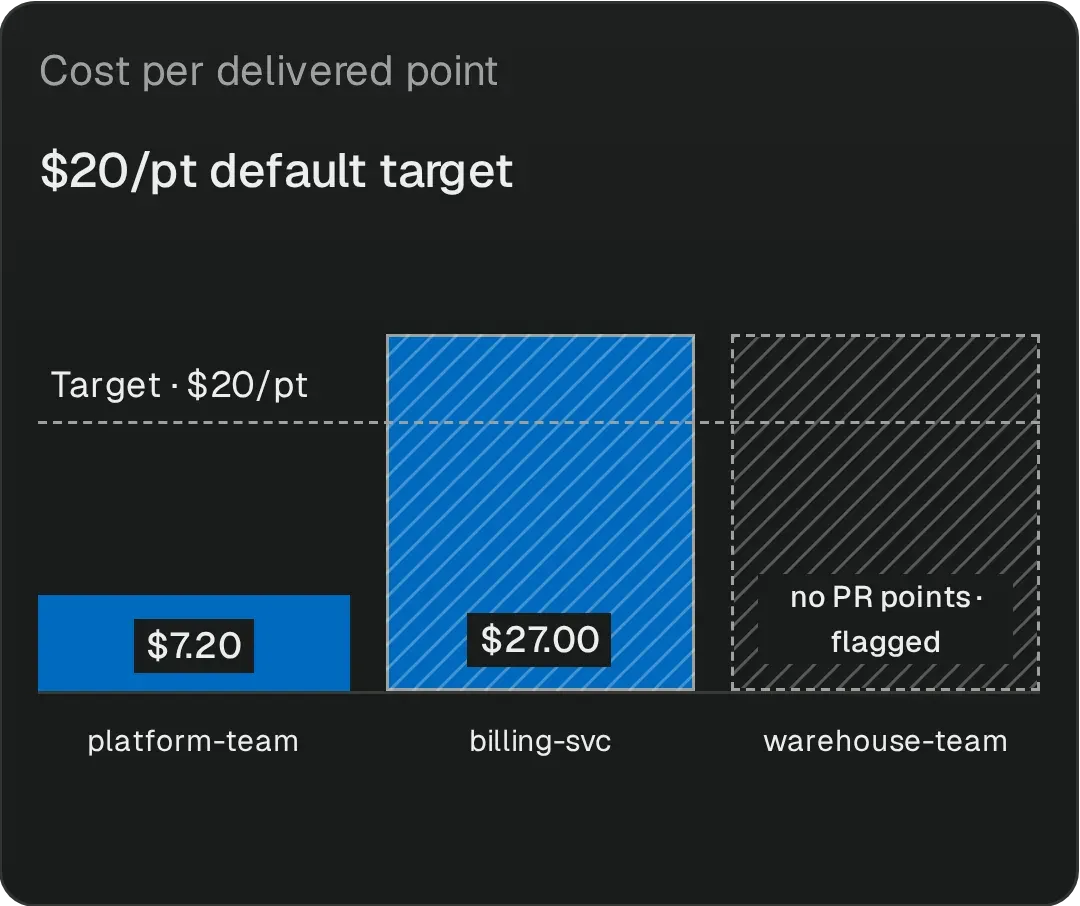
Compare cost per point per owner to decide where an expensive model is worth keeping.
PR scoring
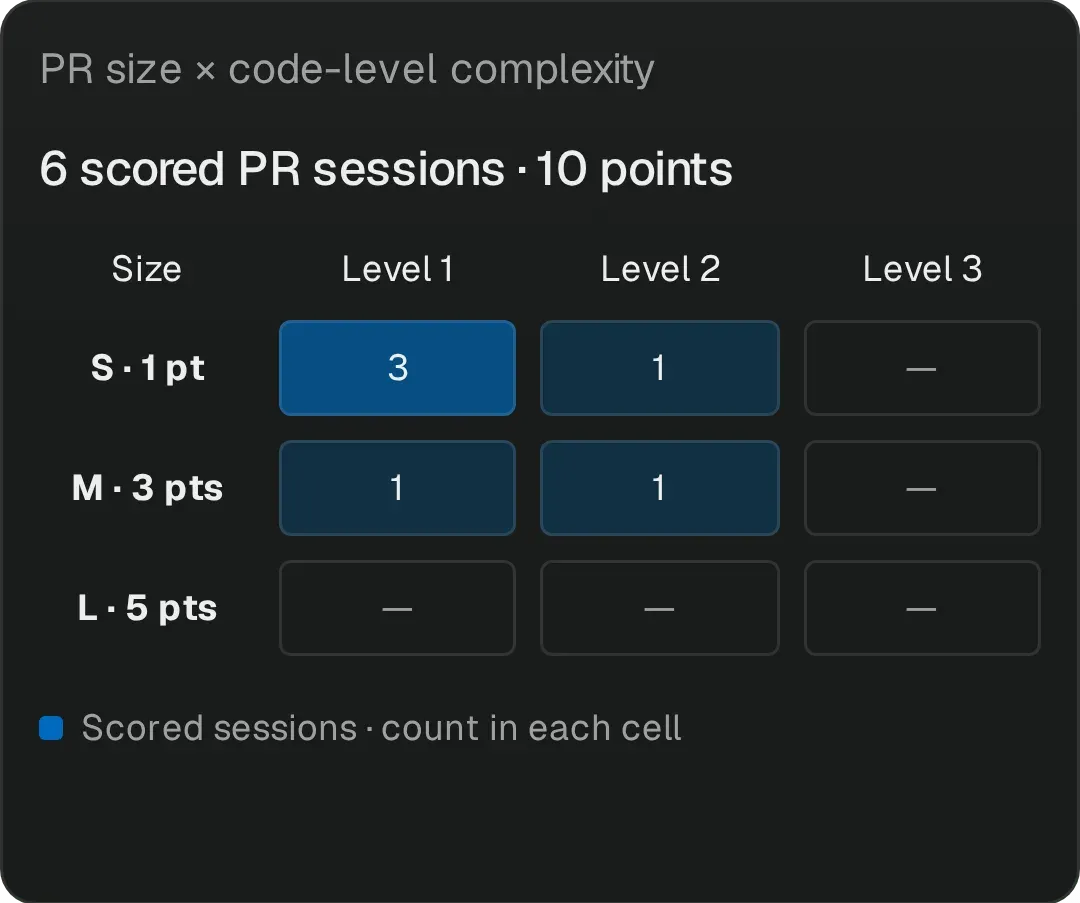
PR size sets delivery points; code-level complexity adds context, not more points.
Model routing
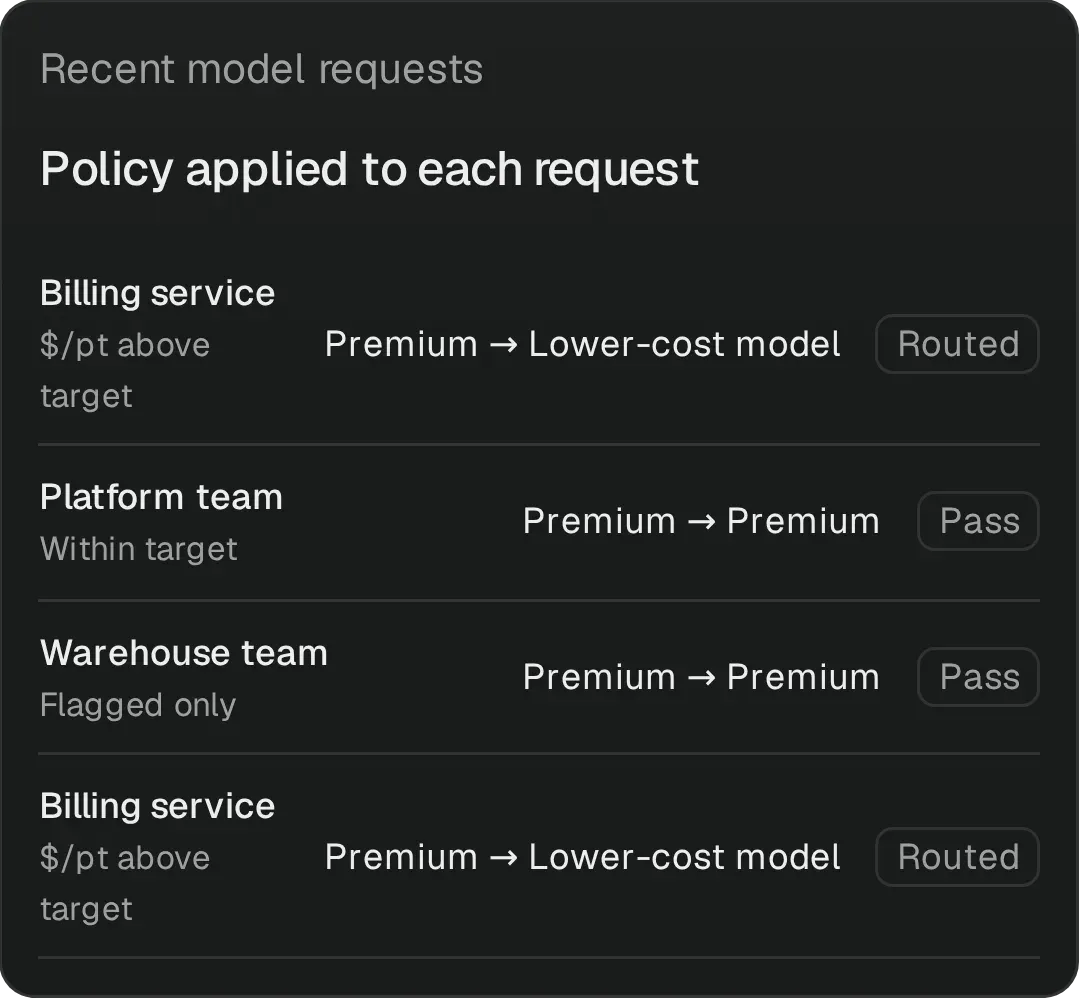
Route premium requests to a lower-cost model; investigate low delivery without blocking models.
Compare the cost of token usage with the tasks that sessions delivered. Use USD per delivery point ($/pt) for each owner over a configurable 14-day window.
Your session data stays on your host. Send agent requests to any OpenAI-compatible endpoint or LiteLLM provider, including OpenAI, Gemini, vLLM and Ollama, or Bedrock or Anthropic.
Your host or VPC
One Docker Compose deployment. A proxy key and a password-protected dashboard.
Agent requests + context
Your model providerPR scoring + code context
PR scoring model (cloud or local)Scored sessions today come from Claude Code. The proxy supports any OpenAI-compatible endpoint or LiteLLM provider, including OpenAI, Gemini, vLLM and Ollama, or Bedrock or Anthropic. Routing matches requested model names that contain opus and uses Sonnet as the default fallback. You can configure a fallback from any provider. PR scoring uses Qwen on Bedrock or local Ollama. Other agents can connect through compatible APIs, but their sessions are not scored yet; API compatibility does not mean that every client tool message can be scored.
No. Points measure PR-sized output, not business impact, production success or code quality. PR is an output classification, not proof of an opened pull request, merge or deployment. Use the data with a review of the work, not as a complete measure of value. Do not use it to rank people or dismiss non-PR work.
PR size determines points: Z 0, XXS 0.15, XS 0.5, S 1, M 3, L 5 and XL 8. Complexity does not change points. Doc, research, ops and nothing earn no points, but their costs count in the owner rating. Ratings compare USD per delivery point ($/pt) per owner (a person, team or service key) over a configurable 14-day window.
The owner, models, backend, tokens, cost, output type, files changed, tool calls and recorded commit SHAs. Records come from supported tool messages, not a full filesystem audit. Repeated edits to existing files can count the same lines more than once.
When the session ends, or on demand from the admin dashboard. The session record supplies the work for local Laya classification. The PR scoring model evaluates cleaned diff, summary, features, magnitude and code-level complexity. Other types get no size and no complexity.
Impact-based routing compares token spend with delivered tasks as USD per delivery point ($/pt) per owner. You can configure the rating window, minimum session count, spend thresholds and fallback model. The defaults require 3 scored sessions in 14 days. At least 1 point and cost above $20 per point routes premium requests to the configured lower-cost model. Below 1 point and cost above $40 flags low delivery only. These settings apply across owners; this is not an arbitrary model-routing rule builder.
Missing, unreadable or expired ratings leave the requested model unchanged. A low-delivery flag also leaves it unchanged. Only a premium-model request from an owner marked for fallback uses the lower-cost model.
Ratings apply per owner (a person, team or service key). The owner email is a client-supplied label, not an authenticated identity. Use the shared-key proxy only with trusted clients.
It depends on the endpoints you configure. Agent requests and their conversation and code context go to the model provider or OpenAI-compatible endpoint that you configure. Qwen scoring sends session and code context to Bedrock unless you use local Ollama. Session artifacts, scores, ratings, the dashboard and Laya stay on your host.
Book a call to discuss an on-prem deployment on your host or VPC. A single Docker Compose deployment provides the proxy, scorer and password-protected admin dashboard. Session data stays in files on your host. Use a protected network with firewall and TLS controls; the deployment has no built-in TLS.