How it works
How Pensero measures delivery, and what you do with it
Every piece of work scored in delivery points, with cost and quality beside it.
How a delivery point is scored
- Step 1
What we measure
Code changes, reviews, tickets, documents, discussions and agent sessions in connected tools. A contribution earns points only when there is evidence that it is meaningful. Activity alone earns nothing.
- Step 2
How we measure it
Magnitude × complexity. Magnitude is the size of the real change (XXS 0.15 · XS 0.5 · S 1 · M 3 · L 5 · XL 8). Complexity is how hard it was to deliver (1.0 → 3.0), across code, system design, delivery, communication and ownership.
- Step 3
Worked example
An example work item in the product: Add workspace setup to self-serve onboarding. Large 5.0 × Medium 2.0 = 10.0 points.
- Pull request #4291MergedOpened by Varrow Migration Agent for Customer Portal10.0
- PR: Add workspace setup step12 files · +284 −926.0
- Ticket edit · ONB-412Description and acceptance updated5.4
- Comment on ONB-412Agreed approach with the Growth team3.0
- 3 Slack messages#growth-onboarding channel0.0
Magnitude × complexity
- A big but straightforward changeL 5 × 1.0 =5 points
- A smaller but harder changeS 1 × 3.0 =3 points
Add workspace setup to self-serve onboarding
- MagnitudeLarge • 5.0
- ComplexityMedium • 2.0
- Item delivery(5.0 × 2.0)10.0
Consistent criteria and traceable evidence
- Teams
- Providers
- Humans
- Agents
The same criteria, calibrated against Pensero’s benchmark
Every point traces back to
- Pull request
- Ticket
- Document
What discourages gaming
- BoilerplateLock files, generated code, migrationsRemoved
- MagnitudeCapped
- Reverts and duplicatesNo credit0.0
Nothing is counted twice. Scores can change when new evidence comes in.
What is not in the point
Magnitude×Complexity=Points
Not in the formula. Pensero shows them beside the point
- Cost
- Time
- Quality
Engineering teamsusing Pensero


Connected in an hour. Your first baseline in a day.
1 hour
Connect
Connect GitHub, Jira, Devin and your AI assistants, in your own repos or your client’s. Pensero only needs read access, and nobody changes how they work.
1 day
See your baseline
Every piece of work is scored on one scale, whether a person, an AI-assisted engineer or an agent did it. You see four measures: AI cost per delivery point, model fit, agentic maturity and defect cost.
1 week
Benchmark and price
Compare your numbers with 200+ organizations. You come out with a price per delivery point you can defend in a proposal.
No guesswork. The baseline places you on all 5 levels.
- 1xL1
Human-only
Humans write all the code
- +30%Most teams are hereL2
AI-assisted
Engineers write with AI tools like Copilot or Cursor
- +50%L3
AI reviews
Humans write, AI checks the work
- 3xL4
Orchestrated agents
Agents carry out whole tasks, humans direct and review
- 4xL5
Fully autonomous agents
Agents start and deliver work, humans govern
Your firm allocates delivery, not hours. Pensero certifies it.
Agents cut the humans a project needs. Priced per delivery point, your firm keeps the gain from every point.
PenseroConnects GitHub, GitLab, Jira, Linear, Copilot, Cursor, Claude Code and Devin, in the cloud or on-prem.
How much delivery is AI-assisted?536 AI-assisted points, 14% of delivery- Human-only
- AI-assisted
- AI-augmented review
- Agentic
PenseroThe 200+ organization benchmark makes the quote comparable and credible.
Metric Your value Pensero median Your percentile (6M) Delivery per headcount 58.3 41.2 P84 AI user adoption 88% 62% P86 AI cost per delivery $1.48 $1.86 P72 Agentic cost per delivery $0.84 $1.10 P78 Defect cost % 9% 13% P66 PR Cycle Time 96.4h 118.0h P58 Roadmap alignment 68% 57% P74 PenseroScores every PR and ticket as it happens.
How much delivery lands at each agentic maturity level?6,010 pts · 67% at level 4+ · 33% below- Human-authored
- AI-assisted
- AI-augmented review
- Orchestrated agents
- Autonomous agents
Top agentsVarrow Migration Agent388 ptsVarrow Test Agent341 ptsVarrow Review Agent276 ptsVarrow Triage Agent228 pts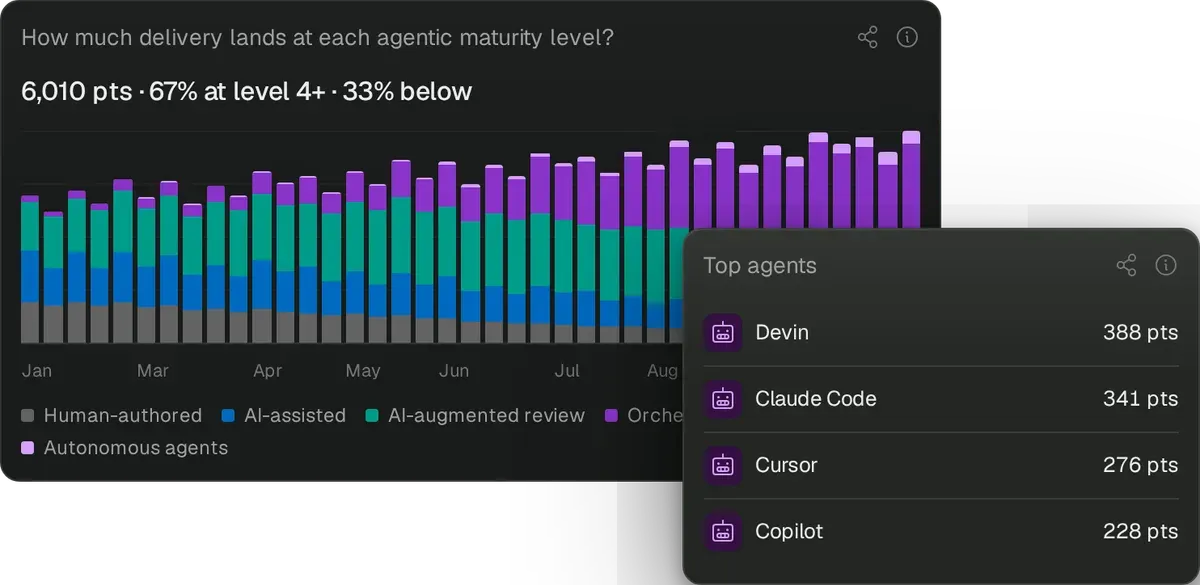
PenseroDelivers the evidence inside the workflow, through MCP.
Defect cost %1.8pp6%of delivery went to bug fixesRework rate2.4pp11%spent rewriting codeRevert rate0.6pp1.4%of PRs were revertedHow much delivery cost to fix bugs?6.2% of delivery this period cost to fix bugs- Own defect cost %
- Orchestrated defect cost %
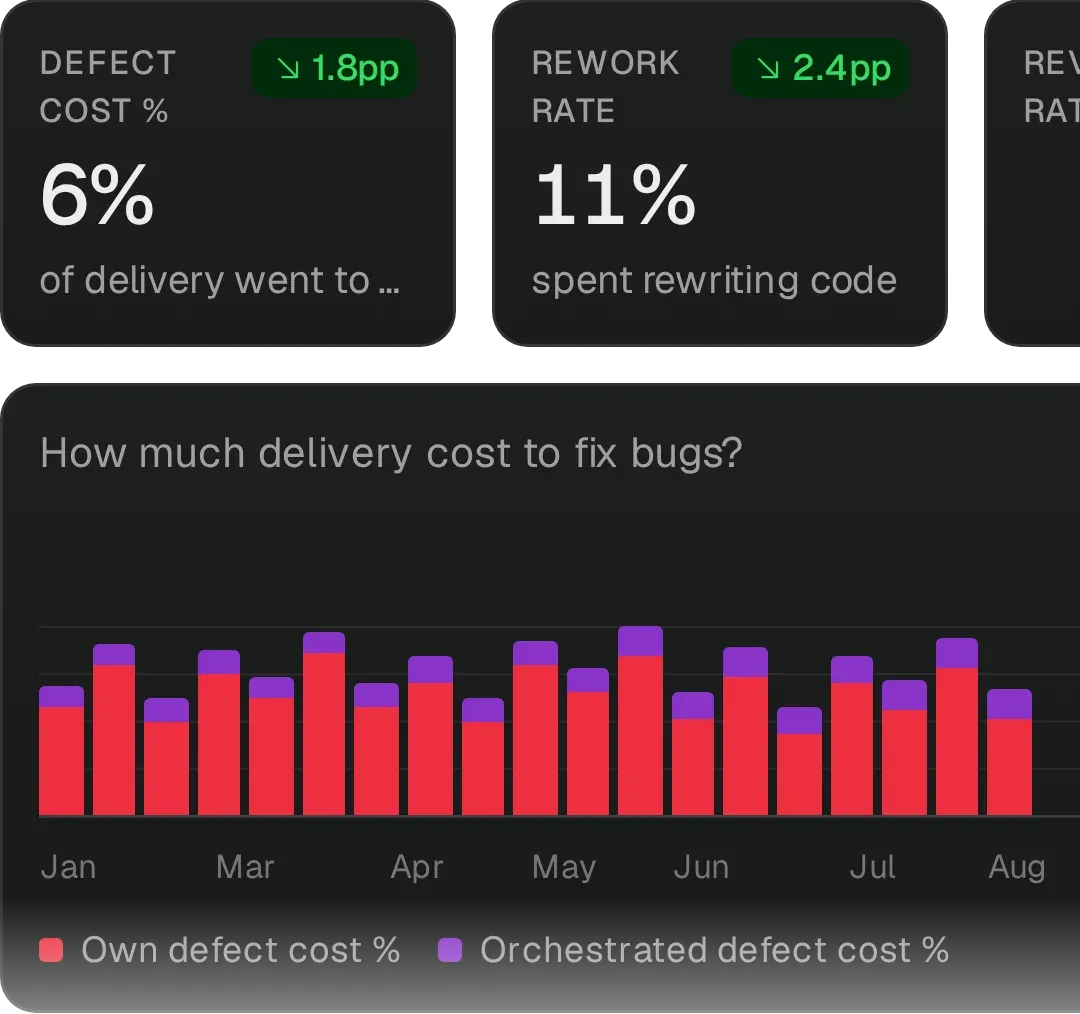
PenseroMeasures what held, so your track record compounds.
Other tools measure activity. Pensero certifies delivery.
Pensero scores accepted delivery points as a neutral operator: one unit across humans, vendors and agents.
- Captures the whole workflow: code, tickets, docs, agents, tokens.
- One unit, calibrated on 200+ organizations and 2M+ PRs and tickets.
- Acts inside the workflow: 80% of traffic through MCP.
- Does not deliver the work, so no vendor grades its own return.
- Rules both sides rely on: acceptance and dispute.
- Pull request #429110.0
- PR: Add workspace setup step6.0
- Ticket edit · ONB-4125.4
- Comment on ONB-4123.0
Pull request #4291
12 files · +284 −92
MeasuresTheir own activity
VCVarrow CTOAccepted
Certified by Pensero10.0 pts
Ready for your client’s security review
Pensero reads the client’s systems with read access only and runs where the client needs it to.
See the Pensero trust center →SOC 2 Type II
GDPR compliant and HIPAA aligned.
 Type II
 Compliant
 Compliant
SAML SSO and SCIM
Audit logs and 24/7 monitoring.
Cloud, on-premise or hybrid
Pensero Cloud, an EU deployment or the client’s own cloud account.
Configurable retention
Custom APIs, MCP access and a contractual SLA.

“Automation, standardization, and time savings was our primary goal.”
Nick TraylorHead of Engineering, StordRead story → 
“And the best part: it was truly plug-and-play — we were live in just one day.”
Jean-François LegourdCo-founder, Elfie 
“With Pensero we go 4x faster.”
Andrew EyeCEO and Founder, ClosedLoopRead story → 
“It’s a plan of going step by step, moving on a quarterly basis.”
Jordi AbadCTO, SEAT CODERead story → 
“Now we went from 70% to 30% maintenance… it’s where we want it to be.”
Ignasi VegasCEO and Co-founder, CubboRead story →